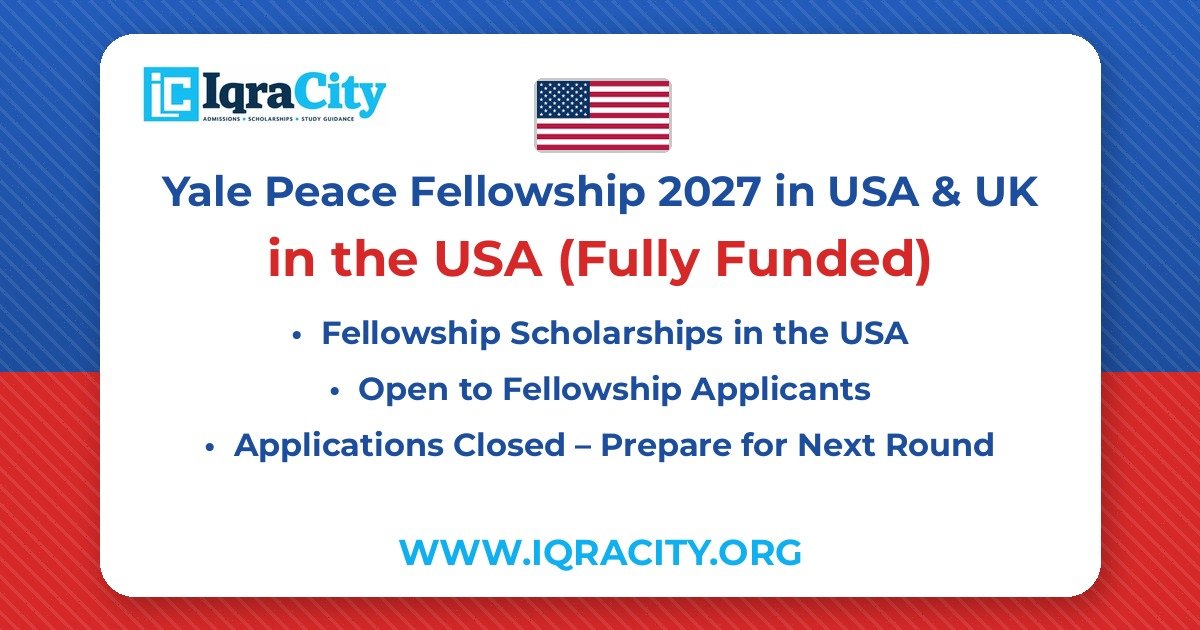
If you work on the frontlines of peace — mediating in communities torn by conflict, running reconciliation programs, advising governments on transitional justice — this is one of the few fellowships built exactly for you. Each year, the Yale Jackson School of Global Affairs selects just 16 rising peace leaders from around the world for the Yale Peace Fellowship, a fully funded program that combines a week-long seminar at Yale University, months of virtual negotiation and media training, and a closing convening at Rose Castle in the United Kingdom. Travel, food, lodging, and seminar costs are covered for both in-person components.
In short: The Yale Peace Fellowship is a fully funded leadership program for working practitioners in peacebuilding, conflict prevention, and post-conflict reconciliation. It ran at Yale (12–16 April 2027) and Rose Castle, UK (13–18 June 2027) with virtual sessions in between. Applications for the 2027 cohort closed on 9 September 2026 at 14:00 Eastern time — this guide prepares you for the next round.
Quick Overview
- Host Country: USA (New Haven, Connecticut) & UK (Rose Castle)
- Host Institution: Yale Jackson School of Global Affairs
- Degree Level: Fellowship (for working professionals, not students)
- Program Duration: Blended format, April–June 2027
- Funding Type: Fully Funded
- Deadline: 9 September 2026, 14:00 Eastern Time (2027 cohort closed)
Benefits of the Yale Peace Fellowship
Sixteen fellows each year — and the financial barrier is essentially removed:
- 100% of travel costs covered — Yale covers all travel, food, lodging, and seminar costs for both required in-person components: the Yale opening seminar and the Rose Castle closing convening.
- No tuition or program fees — The entire program, including all virtual sessions, is free for selected fellows.
- World-class leadership training — Negotiation training, media training, and strategic communication coaching from Yale faculty and expert practitioners.
- A lifelong global network — Fellows join a growing community of peace leaders across sectors and regions — diplomats, civil society leaders, religious figures, social entrepreneurs — who lean on each other long after the program ends.
- Space to reflect and regroup — Peace work burns people out. The closing week at Rose Castle is deliberately built for reflection: revisiting your own journey and consolidating lessons before returning to the field.
A note on honesty: this fellowship is designed for people already doing the work, not students or career-switchers. If your experience is academic rather than field-based, other programs (like the Rotary Peace Fellowship) may fit better.
Eligibility Criteria for the Yale Peace Fellowship
- Working practitioners in peace and reconciliation — Applicants should be accomplished in the field, with a track record of strong leadership, a drive to grow professionally, and demonstrated commitment to cross-cultural understanding. Selection rewards demonstrated impact, not just credentials.
- Non-US citizens — Applicants must be citizens of a country other than the United States. Dual US citizens are eligible, but strong preference is given to candidates whose work is focused outside the US.
- English fluency essential — Full participation requires fluency in English.
- Full availability required — Fellows must be available for every part of the program, including both in-person weeks: Yale campus (12–16 April 2027) and Rose Castle, UK (13–18 June 2027). These cannot be done remotely.
- Diverse professional backgrounds welcome — Fellows come from civil society, diplomacy, politics, religion, and social enterprise. Admission is highly competitive, and each cohort is geographically balanced across regions and professions.
How to Apply for the Yale Peace Fellowship
1. Read the official program page — Start at the Yale Peace Fellows page on the Jackson School website to confirm the current cohort's timeline and requirements. 2. Prepare your materials — You'll need a résumé or CV (maximum three pages), a personal statement (maximum 600 words) explaining your experience, leadership journey, motivation, and contribution to peacebuilding, and one letter of recommendation (Yale accepts no more than one). 3. Record your video statement — A 90-second video statement, recorded directly in the application system. Keep it sharp: who you are, what you've done, and why this fellowship matters for your impact. 4. Complete the online application — The process is entirely online with no paper forms. You can start, pause, and return to your application at any time before the deadline. 5. Pay the $20 application fee — An electronic application fee of $20 is required to submit your application. 6. Submit before the deadline — No extensions are granted, and revised materials cannot be submitted afterward unless the selection committee specifically requests them. 7. Wait for the admissions team — Successful applicants are contacted directly with next steps. Only selected candidates are notified.
Required Documents
- CV or résumé — Maximum three pages
- Personal statement — Maximum 600 words, covering your experience, leadership journey, motivation, and contribution to peacebuilding
- Video statement — 90 seconds, recorded in the application system
- One letter of recommendation — Only one is accepted
- $20 application fee — Electronic payment with submission
Yale Peace Fellowship Deadline
Applications for the 2027 cohort closed on Wednesday, 9 September 2026 at 14:00 Eastern time. There are no extensions and no late submissions.
If you missed it, the fellowship runs annually — the pattern is a late-summer application deadline each year, with the program running roughly April to June the following year. Use this year to deepen your field impact, because selection is driven by what you've actually done, not what you plan to do. Watch the official Yale Jackson School page for the 2028 cohort announcement.
Frequently Asked Questions
Is the Yale Peace Fellowship really fully funded?
Yes. Yale covers 100% of travel, food, lodging, and seminar costs for both in-person components — the Yale seminar and the Rose Castle convening. There are no tuition or program fees. The only cost to applicants is the $20 application fee, which is paid when submitting.
Who is this fellowship for?
Working practitioners already engaged in peacebuilding, conflict prevention, mediation, diplomacy, humanitarian work, community leadership, or post-conflict reconciliation. The program explicitly looks for demonstrated impact and leadership, not academic credentials — field experience is the core currency.
Can US citizens apply?
Applicants must generally be citizens of a country other than the United States. Dual US citizens are eligible, but the program gives strong preference to candidates whose work is focused outside the US. This is a deliberate design choice to serve leaders working in conflict-affected contexts.
What does the program schedule look like?
For the 2027 cohort: a week-long in-person seminar at Yale (12–16 April 2027), interactive virtual sessions every two weeks from April to June 2027 (negotiation training, media training, strategic communication), and a closing international convening at Rose Castle in the UK (13–18 June 2027).
Where does the international convening take place?
At Rose Castle in the United Kingdom. This was a change for the 2027 cohort — earlier cohorts travelled elsewhere, so don't rely on older reports about the closing venue.
How many fellows are selected?
Sixteen each year, geographically balanced and drawn from a wide range of professions, cultures, and perspectives.
What is the 90-second video statement?
A short video recorded inside the application system where you introduce yourself and make your case. Treat it like a pitch: who you are, what you've achieved in peacebuilding, and why the fellowship would multiply your impact.
Is there an age limit or degree requirement?
No age limit is stated, and the fellowship does not require a particular degree. Selection is based on professional accomplishment and leadership in peace and reconciliation — which in practice means established practitioners, not recent graduates.
Can I reapply if I was not selected?
Yes — if you've been rejected, strengthen the one thing that matters most: your demonstrated field impact. More time on the frontlines, measurable outcomes, and a sharper personal statement are what move a re-application forward.
How is this different from the Rotary Peace Fellowship?
The Yale Peace Fellowship is a short, intensive leadership program for established working practitioners (a few months, blended), while Rotary Peace Fellowships are full academic programs (master's degrees or professional development certificates). Yale's is better if you're mid-career and can't leave your work for a year; Rotary fits if you want a degree.
Final Words
Peace work is some of the hardest leadership on earth — and the loneliest. The Yale Peace Fellowship doesn't just sharpen your negotiation and communication skills; it plugs you into a global family of people doing the same impossible work in different contexts. With the 2027 cohort closed, the smartest move now is to spend the year building the track record that makes a 2028 application undeniable.
Related Scholarships
More opportunities you may also qualify for:
- Wilson Center Research Fellowship 2027–28 | Fully Funded USA Fellowship · USA • Fully Funded
- GEM Fellowship Program 2027 in USA | Fully Funded STEM Fellowship · USA • Fully Funded
- Stamps Scholars Program 2027 in USA (Fully Funded) · USA • Fully Funded
- Johns Hopkins Bloomberg Fellows Program 2027–28 | Fully Funded MPH or DrPH · USA • Fully Funded