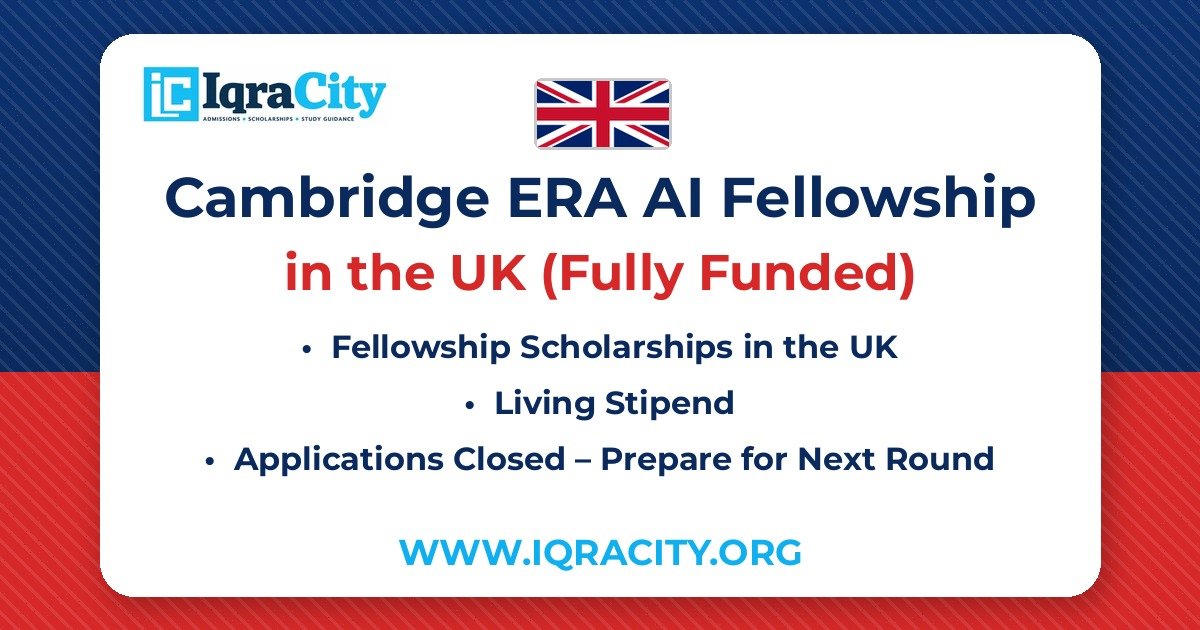
Imagine spending ten full weeks in Cambridge, thinking deeply about the biggest questions in artificial intelligence, surrounded by brilliant people from around the world — and getting paid £10,000 to do it. That's the Cambridge ERA AI Fellowship: a fully funded research programme run by ERA, a Cambridge-based organisation devoted to reducing risks from advanced AI. The Winter 2027 cohort was one of their largest ever, bringing together around 30 to 35 fellows across three research streams.
Here's the honest headline first: the Winter 2027 application window closed on 13 September 2026, so this round is already decided. But ERA has run this fellowship every year since 2021, with 85+ alumni across more than 10 countries — the next round is well worth preparing for now.
In short: The Cambridge ERA AI Fellowship is a 10-week, fully funded AI safety research programme in Cambridge, UK (18 January – 26 March 2027). It offers a £10,000 stipend plus travel, visa, lodging and meal support to researchers and professionals aged 18+ from any country. The 2027 deadline (13 September 2026, 11:59 PM AoE) has passed; this guide prepares you for the next cycle.
Quick Overview
- Host Country: United Kingdom
- Host Institution: ERA (Cambridge)
- Degree Level: No formal degree requirement — all career stages welcome
- Program Duration: 10 weeks (18 January – 26 March 2027)
- Funding Type: Fully Funded (stipend + travel + visa + lodging + meals)
- Deadline: 13 September 2026, 11:59 PM Anywhere on Earth (AoE, UTC−12) — Winter 2027 round closed
Benefits of the Cambridge ERA AI Fellowship
ERA covers virtually everything so you can focus entirely on research. Here's what fellows got in the 2027 cycle:
- £10,000 stipend — a competitive, pro-rated salary-equivalent paid to every fellow for the ten weeks.
- Lodging covered — accommodation in Cambridge is provided or paid for, so you don't have to hunt for housing.
- Travel support — international travel costs to and from Cambridge are covered.
- Visa support — ERA assists with UK visa arrangements for international fellows.
- Meals during working hours — food at the office is covered so long research days don't cost you extra.
- Dedicated desk space — a personal workspace at the ERA office in Cambridge, right in the middle of the research community.
- Expert mentorship — pairing with experienced mentors and research managers who help shape your project.
- Research management support — dedicated help with scoping, planning and executing your research.
- Community and networking — regular social events, seminars and access to Cambridge's thriving AI safety community.
Eligibility Criteria for the Cambridge ERA AI Fellowship
ERA takes a deliberately talent-first approach — there's no formal degree or subject gate. That said, these are the hard and soft rules:
- Age 18+ — you must be at least 18 by the time the programme starts.
- Any nationality — applicants from all countries are welcome; no citizenship restriction.
- Any career stage — PhD students, early-career researchers, working professionals and established experts all apply.
- Relevant expertise or interest — backgrounds in computer science, engineering, policy, law, security, economics or related fields are common, but ERA explicitly welcomes people from outside AI research too.
- No IELTS or TOEFL — no formal English test requirement is stated.
- In-person commitment — the fellowship is full-time and residential in Cambridge for the full ten weeks.
- No application fee — applying costs nothing.
How to Apply for the Cambridge ERA AI Fellowship
The application ran online through ERA's official application form (an Airtable form on erafellowship.org). Here is how the Winter 2027 process worked — expect the same skeleton next round:
1. Read the official fellowship page and FAQ — understand the three research streams (Technical AI Safety, AI Governance, Technical AI Governance) and pick where you fit. 2. Submit the online application — essays and questions about your background, research interests and motivation. ERA takes AI safety seriously: do not use AI tools to write your application text — all writing must be your own. 3. Stage 1: written application review — ERA screens for talent, motivation and research potential. 4. Stage 2: first interview — roughly the top 20% of candidates were invited to first-round interviews in late September 2026. Expect deep questions about your interests, reasoning and research direction. 5. Stage 3: second interview — particularly promising candidates get a shorter second interview in early October, and ERA contacts your references at this point. 6. Stage 4: offers and project development — successful applicants receive offers, then work with ERA staff to develop and refine their project ideas before the programme starts. 7. Relocate to Cambridge — arrive for 18 January 2027 and spend ten weeks on full-time research.
Required Documents
- Online application form — essays and written responses on your own work.
- CV or résumé — outlining your background, skills and experience.
- References — referees contacted during the interview stage; have them ready.
- Writing or project samples — links to code, papers or projects strengthen your case (especially for technical streams).
- Valid passport — start any renewal early; ERA supports the visa process but you need travel documents.
Cambridge ERA AI Fellowship Deadline
Applications for the Winter 2027 cohort closed on 13 September 2026 at 11:59 PM Anywhere on Earth (AoE). If you missed it, don't despair: ERA has run fellowships every year since 2021, including a Summer 2026 cohort (6 July – 11 September 2026) and this Winter 2027 one. The pattern suggests another cohort in 2027 — watch erafellowship.org and join their interest list so you're ready the moment the next call opens.
Frequently Asked Questions
Is the Cambridge ERA AI Fellowship really fully funded?
Yes. Every fellow receives a £10,000 stipend plus covered travel, visa support, lodging and meals during working hours. ERA also notes that in special cases they provide extra financial support for impactful career transitions into AI safety or policy.
Do I need a background in AI research to apply?
No. ERA explicitly encourages applications from people outside traditional AI research — early-career researchers, PhD students and working professionals from computer science, engineering, law, security, economics and other fields. What matters is your ability to contribute to AI safety or governance research.
What are the research streams?
Three streams: Technical AI Safety, AI Governance, and Technical AI Governance. You choose the one closest to your interests and skills, and ERA matches you with mentors and research managers in that area.
Do I need a finished research proposal to apply?
No. You don't have to arrive with a fully finalised proposal. After offers are made, ERA works with you to develop and refine your project ideas with mentors before the fellowship begins.
Can I participate remotely?
No — the fellowship is full-time and in person by default, at the ERA office in Cambridge. The residential design is intentional: breakthrough ideas come from close collaboration and spontaneous conversation.
Is there an age limit or degree requirement?
You must be 18 or older when the programme starts, but there is no formal degree requirement and no stated upper age limit. No IELTS or TOEFL is required either.
How competitive is it?
Very. Around the top 20% of applicants reach the first interview stage, and the final cohort is roughly 30 to 35 fellows. Strong applications show genuine reasoning, a clear theory of change for reducing AI risks, and relevant experience.
Can I use AI tools to write my application?
Absolutely not. ERA requires all application text to be your own work. Using AI-generated text in the application is against their rules.
Who runs ERA?
ERA is a Cambridge-based organisation (sometimes described as the Cambridge Existential Risk Alliance) focused on AI safety research and community-building. Since 2021 it has supported 85+ fellows across 10+ countries.
When will the next cohort open?
ERA typically announces cohorts a few months before deadlines, running summer and winter cycles. The Summer 2026 round closed in April 2026 and Winter 2027 in September 2026. Register your interest on erafellowship.org so you don't miss the next call.
Final Words
The ERA Fellowship is one of the few programmes in the world that pays you a proper salary to think hard about AI safety in one of the world's best research towns. The Winter 2027 round is closed, but the fellowship returns regularly — and the application bar rewards genuine thinking, not credentials. If this field calls to you, start now: read the research, follow ERA's updates, and build the profile that makes your next application undeniable.
Related Scholarships
More opportunities you may also qualify for:
- Chevening OCIS Fellowship 2027 in the UK | Fully Funded to Oxford · UK • Fully Funded
- Commonwealth Fellowships 2027 in the UK | Fully Funded · UK • Fully Funded
- Chevening LSE Fellowship 2027 in the UK | Fully Funded · UK • Fully Funded
- Chevening British Library Fellowship 2027 in the UK | Fully Funded · UK • Fully Funded