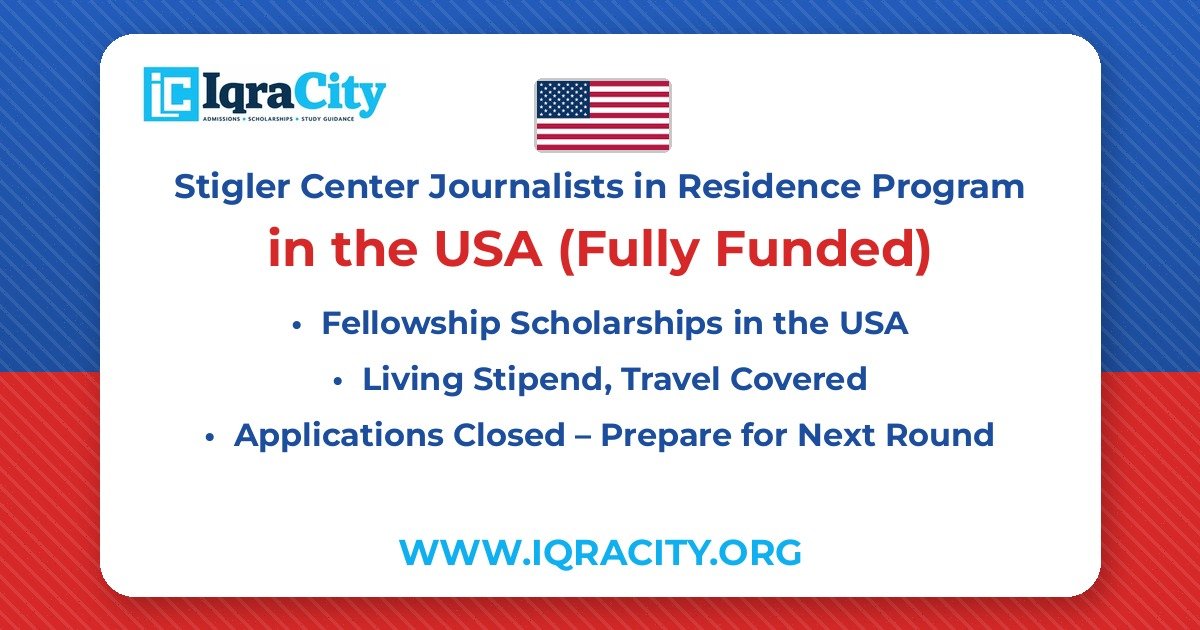
Twelve weeks on one of the world's most famous university campuses, sitting in on classes with Nobel laureates, writing for an economics publication, networking with reporters from a dozen countries — and getting paid $14,000 to do it. The Stigler Center Journalists in Residence Program Program at the University of Chicago Booth School of Business has been doing this since 2017, and it is one of the best-funded journalism fellowships on the planet. A quick heads-up: applications for the Spring 2027 cohort closed on 20 September 2026, so treat this article as your complete preparation guide for the next intake.
In short: The Stigler Center Journalists in Residence Program Program 2027 was a fully funded, roughly 12-week residency at the University of Chicago for experienced journalists worldwide, with a $14,000 stipend, airfare and visa-fee reimbursement. The Spring 2027 cohort (tentatively 15 March–31 May 2027) application deadline was 20 September 2026, 11:59 p.m. Chicago time — decisions arrive by the end of December 2026.
Quick Overview
- Host Country: United States
- Host Institution: University of Chicago Booth School of Business (Stigler Center for the Study of the Economy and the State)
- Degree Level: Professional development program for working journalists (no degree awarded)
- Program Duration: Approximately 12 weeks
- Funding Type: Fully funded — $14,000 stipend + airfare, SEVIS and visa fee reimbursement
- Deadline: 20 September 2026, 11:59 p.m. CT Chicago time (for Spring 2027 — now closed)
Benefits of the Stigler Center Journalists in Residence Program Program 2027
This is a genuinely generous package, confirmed directly on the Stigler Center's official page. Here is what the 2027 cohort received:
- $14,000 stipend — To cover living expenses over the 12-week program. Note it is subject to up to 14% tax withholding for international participants, depending on your country's tax treaty with the United States.
- Airfare reimbursement — Economy-class airfare to and from Chicago is reimbursed.
- Visa and SEVIS fee reimbursement — International participants are usually issued J-1 visas, and the visa application and SEVIS fees are reimbursed.
- Health insurance — Provided through the University of Chicago's student/visitor plan. It is mandatory, paid out of the stipend (waived only if you can prove equivalent coverage).
- Audit three classes at Chicago Booth — You sit in on real MBA courses at one of the top business schools in the world, completing readings and assignments alongside students.
- Seminars and workshops — Participation in Stigler Center seminars, lectures, conferences and social events, plus workshops across the university.
- Write for ProMarket — An opportunity to publish with the Stigler Center's digital publication (encouraged, not required).
- Faculty and cohort collaboration — Direct interaction with Booth faculty, researchers, students and a cohort of journalists from outlets like the BBC, Financial Times, The New York Times, Reuters and Bloomberg.
- Housing guidance — Resources and advice for finding short-term accommodation in Chicago.
- Certificate of participation — Awarded on successful completion (the program does not confer a university or MBA degree).
The honest money advice, straight from the program's own FAQ: stipend disbursement can take up to one month to process after the program begins, so plan to have roughly $3,000–$5,000 of your own money to cover the first month's housing, food and transport.
Eligibility Criteria for the Stigler Center Journalists in Residence Program Program 2027
- Working journalist — The program is for journalists working in all forms of media around the world. You do not need to be a business journalist, though interest in political economy is expected.
- Some years of experience — Strong applicants have at least a few years of post-degree working experience in the field.
- Proficient English — You will be participating in classes and seminars, so solid English is required.
- Interest in political economy — The program exists to deepen journalists' understanding of the relationship between politics, markets, business, economics and public institutions.
- Editors and freelancers welcome — Freelancers and editors apply regularly and are hosted in the program.
- All nationalities — Journalists from any country can apply.
- No application fee — Nothing is charged to apply.
How to Apply for the Stigler Center Journalists in Residence Program Program 2027
Applications for Spring 2027 went through the University of Chicago Booth's application system via the "Apply Now" link on the program page. The window is now closed, but the process will be similar next time:
1. Read the official program page. Study chicagobooth.edu/research/stigler/education/journalists-in-residence-program — benefits, expectations and dates are all spelled out there. 2. Check the FAQ. The JIR FAQ answers most application questions in advance and will save you from emailing the center unnecessarily. 3. Gather your best published work. The application asks you to submit articles that show your best journalism. Pieces on political economy or Stigler-related topics are strongly preferred — even if not required. 4. Write the personal statement. If your published work does not directly touch political economy, use the statement to make the connection and show why this program fits your reporting goals. 5. Complete the online application. Apply through the Chicago Booth application portal before the deadline. 6. Submit early. For 2027 the cutoff was 20 September 2026, 11:59 p.m. Chicago time. With a competitive global applicant pool, do not leave it to the final evening. 7. Wait for the decision. Decisions are announced by the end of December. The center cannot share updates or feedback before then, so patience is part of the process.
Required Documents
- Published articles / work samples — Samples that show your best journalism; political-economy topics preferred. (Confirmed via the official FAQ.)
- Personal statement — Explaining your interest in the program and, where needed, connecting your work to political economy. (Confirmed via the official FAQ.)
- Application form details — Completed through the Chicago Booth application portal; check the portal for the exact current document list before applying, as requirements may be updated for the next cohort.
Stigler Center Journalists in Residence Program Program 2027 Deadline
The application deadline for the Spring 2027 cohort was 20 September 2026 at 11:59 p.m. Central Time (Chicago). Decisions will be announced by the end of December 2026, and the Spring 2027 program runs tentatively from 15 March to 31 May 2027. Missed it? The program has run annually since 2017, so the next cohort's call will open months ahead of its deadline — and the months between now and then are best spent publishing strong work on business, economics and political economy, since that is precisely what the selection favors.
Frequently Asked Questions
Is the Stigler Center Journalists in Residence Program Program really fully funded?
Yes. Participants receive a $14,000 stipend, reimbursement for economy airfare and SEVIS/visa fees, health insurance through the UChicago plan and housing guidance. The one thing to plan for: the stipend can take up to a month to arrive, so bring $3,000–$5,000 of your own for the first month.
I am a freelancer, not a staff reporter. Can I apply?
Yes. The program's FAQ explicitly says editors and freelancers are welcome and are regularly hosted. What matters is the quality and seriousness of your journalism.
How many years of journalism experience do I need?
The center says strong applicants have at least a few years of post-degree working experience. There is no published hard minimum, but this is not a student program — it is built for working journalists.
Do I need an economics degree to be selected?
No. Basic knowledge of economics and accounting is useful — courses will be more challenging without it — but it is not required. What is required is a genuine interest in political economy.
Will I earn a degree from the University of Chicago?
No. You receive a certificate of participation. The center explicitly asks alumni to cite it as "The University of Chicago Booth School of Business — Stigler Center, Journalists in Residence Program (Program Year)" and never to claim an MBA or university degree from it.
Can my partner or children come with me to Chicago?
They may accompany you, but the program supports individual participants only. All costs and arrangements for partners or dependents — travel, housing, insurance — are entirely your responsibility.
What kind of writing will I do there?
You will audit three classes and complete their readings and assignments, attend weekly Stigler seminars, lunch workshops and events, and you can (but are not required to) write for ProMarket, the center's digital publication.
Is there an application fee?
No application fee is listed anywhere on the program page.
How competitive is the program?
The center does not publish acceptance rates, but it receives applications from journalists worldwide each year and alumni come from outlets like the Financial Times, BBC, Reuters, The New York Times, The Wall Street Journal and Bloomberg. Expect serious competition and make your work samples count.
If I applied for Spring 2027 and was not selected, can I apply again?
The program recruits a new cohort each year, so nothing prevents you from applying again. Strengthen the weakest part of your last application — usually the relevance of your work samples to political economy — before reapplying.
Final Words
For a business or economics journalist, few fellowships offer this much for this long: three months at Booth, a real stipend, and a global cohort of peers who end up at the world's biggest newsrooms. The 2027 window may be closed, but the preparation it rewards — sharp, well-reported work on money, power and markets — will make you a better journalist whether or not you get in.
Related Scholarships
More opportunities you may also qualify for:
- Wilson Center Research Fellowship 2027–28 | Fully Funded USA Fellowship · USA • Fully Funded
- GEM Fellowship Program 2027 in USA | Fully Funded STEM Fellowship · USA • Fully Funded
- Stamps Scholars Program 2027 in USA (Fully Funded) · USA • Fully Funded
- Johns Hopkins Bloomberg Fellows Program 2027–28 | Fully Funded MPH or DrPH · USA • Fully Funded