Getting into a research lab at the National University of Singapore — one of the top universities in Asia — is the kind of thing that changes how graduate schools look at your application. The Internship and Research Immersion in Singapore (IRIS)@NUS programme lets outstanding undergraduate and master's students do exactly that: spend two to three months working with NUS faculty on real research projects, with a monthly stipend, travel support, and free on-campus accommodation. Here's everything you need to know, including the honest bit about the deadline.
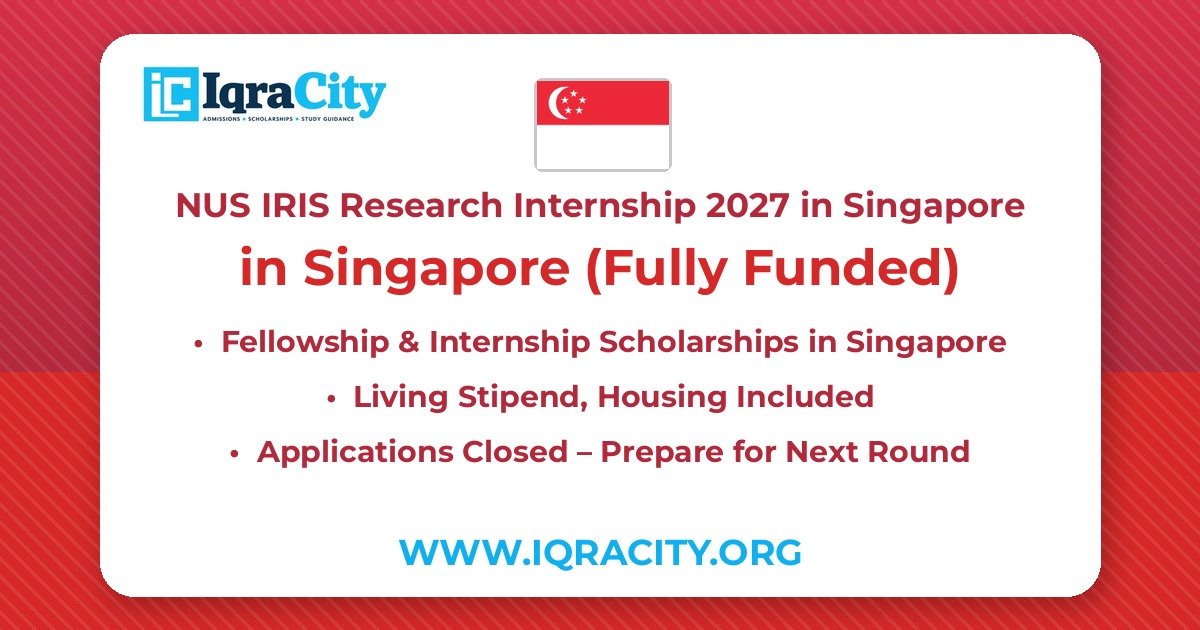
In short: IRIS@NUS is a fully funded research internship run by the NUS Graduate School for undergraduate and master's students from all fields worldwide. The January–May 2027 round offered a SGD 1,200 monthly stipend, SGD 600 travel allowance, and free accommodation. Applications for the 2027 round closed on 28 August 2026, with the next round expected around end of December 2026.
● Applications Closed
Quick Overview
- Host Country: Singapore
- Host Institution: National University of Singapore (NUS Graduate School)
- Degree Level: Undergraduate and Master's students
- Program Duration: Two or three months
- Program Period: January to May 2027
- Funding Type: Fully funded (stipend + travel allowance + accommodation)
- Deadline: 28 August 2026, 23:59 Singapore Time (round closed; next application expected end of December 2026)
Benefits of the NUS IRIS Research Internship
This is a genuinely fully funded programme — the money and support come from NUS itself, so there are no fees to worry about. Here's what selected interns received for the 2027 round.
- Monthly stipend of SGD 1,200 — Paid for each month of your internship to cover daily living expenses in Singapore.
- SGD 600 travel allowance — A one-time allowance toward your airfare and travel costs.
- Complimentary on-campus accommodation — Free housing at NUS, which removes the biggest cost worry of a Singapore stay.
- Certificate of completion — Issued by the NUS Graduate School at the end of the programme.
- Faculty mentorship — Close guidance from NUS professors and active research group members throughout the internship.
- State-of-the-art facilities — Hands-on work in world-class laboratories and research infrastructure.
- Campus life experience — A genuine taste of what it's like to live and study at NUS, useful if you're considering graduate school there.
Eligibility Criteria for the NUS IRIS Research Internship
The eligibility bar is academic, not geographic — students from all fields and countries can apply. The criteria below are taken from the official NUS Graduate School page.
- Minimum GPA of 3.5/4.0 — You need an overall or major GPA of at least 3.5 on a 4.0 scale.
- Undergraduate stage — Undergraduate applicants must have completed at least the first two years of their degree by the time the programme starts.
- Master's stage — Master's applicants must be in the first year of their master's programme at programme start.
- Full-time enrolment — You must be enrolled full-time in a degree-granting programme at your home university.
- Maintain student status — You must remain an enrolled student at your home institution throughout the entire IRIS period; those who graduate before it begins are not eligible.
- Genuine research interest — A sincere interest in academic research is essential; this is not a casual exchange trip.
- No current NUS students — Students already enrolled at NUS are not eligible.
- All academic disciplines welcome — Projects span engineering, sciences, humanities, social sciences, and more.
How to Apply for the NUS IRIS Research Internship
Applications run through the official IRIS@NUS portal on the NUS Graduate School website. The process for the closed 2027 round worked like this, and the next round will follow a similar pattern.
1. Browse the available projects. Before applying, review the official list of faculty projects for the round — interns select up to three preferred mentors and research areas across participating schools and departments. 2. Prepare your documents. Gather your transcript, CV (kept to two A4 pages), personal statement, and arrange your letters of recommendation early. 3. Create an account on the application portal. Register on the official IRIS@NUS application page linked below. 4. Complete the online application. Fill in your personal details, academic background, and research interests, and upload all required documents. 5. Submit before the deadline. The 2027 round closed at 23:59 Singapore Time — late applications are not entertained. 6. Wait for the outcome. Selection is based on academic excellence and demonstrated passion for research, with preference given to ASEAN applicants. Outcomes for the 2027 round were announced in the week of 2 November 2026. 7. Accept and prepare. If selected, complete the acceptance formalities, arrange your visa, and prepare for your research stint in Singapore.
Required Documents
Only list documents the programme actually asks for. For the 2027 round, applicants typically prepared:
- Academic transcript (official, showing your GPA)
- Updated CV, not exceeding two A4 pages
- Personal statement describing your research interests and motivation
- Two letters of recommendation
- Copy of passport (for international applicants)
- Proof of enrolment at your home university
Do check the official portal when the next round opens, as the exact document list can be updated each cycle.
NUS IRIS Research Internship Deadline
The January–May 2027 round's applications closed on 28 August 2026 at 23:59 Singapore Time, and the official page now confirms that applications are closed. If you're reading this now, you cannot apply for the 2027 round — the outcome of that round was announced in the week of 2 November 2026. The good news: the official NUS Graduate School page states that the next application window opens around end of December 2026. That means now is the perfect time to get your CV, transcript, personal statement, and recommendation letters ready so you're not scrambling when the portal reopens. Applications are free — there is no application fee.
Frequently Asked Questions
Is the NUS IRIS Research Internship really fully funded?
Yes. The programme covers a SGD 1,200 monthly stipend, a SGD 600 travel allowance, and free on-campus accommodation, with no application or participation fee. It's funded by the NUS Graduate School itself, so this is a genuine research internship, not a self-funded summer school.
Can I still apply for the 2027 round?
No. Applications for the January–May 2027 round closed on 28 August 2026, and the official page confirms the round is over. Your realistic target is the next application window, expected around end of December 2026 — keep an eye on the official page.
What GPA do I need for IRIS@NUS?
You need a minimum overall or major GPA of 3.5 on a 4.0 scale. This is a hard eligibility criterion on the official page, so if your GPA converts to less than 3.5, you won't pass the initial screening.
I'm in my first year of undergrad. Can I apply?
Not yet. Undergraduate applicants must have completed at least the first two years of their degree by the time the programme starts. First-year undergrads should aim for a later round — and use the extra time to build research experience.
Are students from my country eligible?
Yes. IRIS@NUS accepts applications from students of all nationalities across all academic fields. Preference may be given to applicants from ASEAN countries, but the programme explicitly welcomes applicants from around the world.
How long is the internship, exactly?
The programme runs two to three months within the January to May period. The official programme description describes "two months of intensive research experience," and specific project lengths vary by faculty mentor and research area — you'll see the duration when you browse the project list.
Do I need to find a professor before applying?
No. You don't need to contact faculty in advance. You simply indicate up to three preferred mentors and research areas from the official project list in your application, and NUS matches you with a faculty supervisor based on your research interests.
Does the SGD 600 travel allowance cover my full airfare?
It depends on where you're flying from. For students in nearby ASEAN countries it may cover most of the airfare; for long-haul international flights it's a contribution toward the cost, not necessarily the full ticket. Budget accordingly.
Will this help my chances for NUS graduate school?
It certainly won't hurt. Working directly with NUS faculty, producing research output, and earning a certificate from the NUS Graduate School gives you genuine research experience and a strong relationship with potential supervisors — both of which strengthen any future graduate application.
Can I reapply if I wasn't selected?
Yes. There is no rule against reapplying in a later round. Many applicants improve their CV with new research experience, a stronger personal statement, and better-matched project preferences before trying again. Just make sure you still meet the enrolment and student-status requirements at the new programme start date.
Final Words
IRIS@NUS is one of those rare programmes that combines prestige, genuine funding, and real research output in a single package. The 2027 round may have closed, but the next window opens around end of December 2026 — and that gives you a real runway to prepare a strong application. Start polishing your CV and personal statement now, line up your recommenders, and browse the kind of projects NUS offers so your preferences are sharp on day one.
Related Scholarships
More opportunities you may also qualify for:
- Wilson Center Research Fellowship 2027–28 | Fully Funded USA Fellowship · USA • Fully Funded
- GEM Fellowship Program 2027 in USA | Fully Funded STEM Fellowship · USA • Fully Funded
- UBC Four Year Doctoral Fellowship 2027: Fully Funded PhD in Canada · Canada • Fully Funded
- Harvard Berenson Fellowship 2027-28 in Italy: Fully Funded Research Fellowship · Italy • Fully Funded