Who decides how the internet is governed in the Asia-Pacific region? Increasingly, it's people like you — young leaders, researchers, policy folks, and civil society members who actually show up. The Asia Pacific School on Internet Governance (APSIG) runs a fully funded fellowship every year that brings emerging leaders from across the region together to learn how internet governance really works, meet the experts shaping it, and build networks that last long after the event. The 2026 edition takes place in Taipei, Taiwan, from 29 November to 3 December 2026 — and since the application deadline of 21 August 2026 has now passed, this guide is your playbook for understanding the fellowship and preparing for the 2027 round.
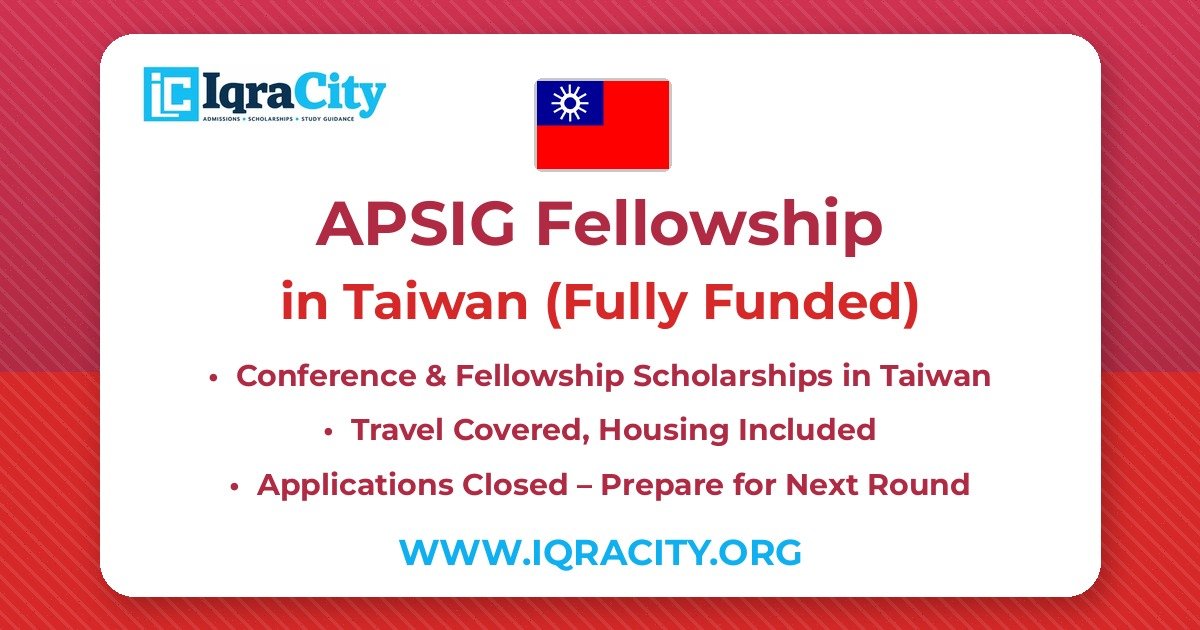
In short: The APSIG Fellowship is a fully funded, 5-day fellowship in Taipei, Taiwan (29 November–3 December 2026) for emerging leaders aged 18+ from the Asia-Pacific region with a genuine interest in internet governance. It covers airfare reimbursement, shared accommodation, meals, and visa fees. The 2026 deadline closed on 21 August 2026 — the next round opens in 2027.
● Applications Closed
Quick Overview
- Host Country: Taiwan
- Host City: Taipei
- Organizer: Asia Pacific School on Internet Governance (APSIG)
- Program Duration: 5 days (29 November–3 December 2026)
- Funding Type: Fully funded fellowship
- Deadline: 21 August 2026, 23:59 (UTC+8) — now closed; next round opens in 2027
Benefits of the APSIG Fellowship
- Fully funded participation — no application fee, and selected fellows receive comprehensive support.
- Airfare reimbursement — your travel to Taipei is covered via reimbursement, so keep your receipts and book sensible fares.
- Prepaid shared accommodation — twin-shared lodging is arranged for fellows during the program.
- Meals covered — food during the program is included.
- Visa fee reimbursement — the cost of your visa application is reimbursed.
- Expert access and networks — direct engagement with internet governance experts, policymakers, and the wider Asia-Pacific community — arguably the most valuable part of the whole experience.
- Relevant themes — the 2026 program touches AI governance, data privacy, cybersecurity, data governance, access and connectivity, diversity and inclusion, and social media governance.
Eligibility Criteria for the APSIG Fellowship
- Age 18 and above — emerging young leaders from the Asia-Pacific region are the target audience.
- Asia-Pacific region — applicants must be from, or based in, the Asia-Pacific region; the exact nationality and residency criteria were stated in the official call.
- Genuine interest in internet governance — demonstrated through participation in meetings, webinars, seminars, or related events; professionals, researchers, scholars, civil society members, and government or NGO representatives all qualify.
- Proficient in English — all sessions are conducted in English, so you need to be able to follow and contribute comfortably.
- Not an APSIG alumnus — previous APSIG fellows are not eligible to apply again.
- Conflict-of-interest rule — staff members, blood relatives, and close associates of APSIG sponsors, the Executive Committee, or Fellowship Committee members cannot apply.
- Engagement commitment — you should be able to share your motivation clearly and explain how you plan to stay involved with the internet governance community after the school.
How to Apply for the APSIG Fellowship
1. Watch for the 2027 call — applications closed on 21 August 2026; the next round is announced on the APSIG website and mailing list. 2. Register on the APNIC Fellowship Portal — applications are submitted through this portal, so create your account early. 3. Fill out the application form — provide your personal information and contact details, and answer all questions carefully. 4. Write a strong motivation statement — explain why you want to join and how you plan to stay engaged with the internet governance community afterward; this carries real weight. 5. Upload supporting documents — your passport and any relevant certificates or awards that support your application. 6. Review and submit before the deadline — late submissions are not accepted; aim to submit well before the final day.
Required Documents
- Valid passport — required for identification and travel arrangements.
- Supporting certificates or awards — any documents that demonstrate your background, expertise, or engagement in the field.
- Motivation and engagement plan — written within the form itself; treat this as the centerpiece of your application.
APSIG Fellowship Deadline
The 2026 fellowship deadline was Friday, 21 August 2026, at 23:59 (UTC+8) — applications closed on that date and are not being accepted. The fellowship itself runs from 29 November to 3 December 2026 in Taipei, Taiwan. APSIG has confirmed that the next round opens in 2027 and will be announced on their website and mailing list, so use this time to build your internet governance profile: attend webinars, join community events, and think seriously about your motivation and post-fellowship engagement plan.
Frequently Asked Questions
Is the APSIG Fellowship really fully funded?
Yes. For the 2026 round, the fellowship covered airfare reimbursement, prepaid twin-shared accommodation, meals, and visa fee reimbursement, with no application fee. These benefits were stated in the official 2026 call — always confirm the exact package in the official announcement for the 2027 round before assuming anything.
Who can apply for the APSIG Fellowship?
Emerging leaders aged 18 and above from the Asia-Pacific region, including professionals, researchers, scholars, civil society members, and representatives of governmental and non-governmental organizations. You do not have to be a technology professional — internet governance is interdisciplinary, and people in policy, law, international relations, and academia are all welcome.
Can students apply?
Eligibility depends on the specific requirements of each round. Students with a demonstrated interest in internet governance may qualify, but check the official call for the 2027 criteria when it is published.
Can I apply if I have attended APSIG before?
No. APSIG alumni are not eligible to apply for the fellowship again — this one is for newcomers to the school.
Do I need a technical background?
No. The fellowship welcomes people from many fields, and applications are encouraged from women, persons with disabilities, and members of other marginalized groups. What matters is genuine interest and a plan to stay engaged afterward.
What is the selection criteria?
The committee looks at your motivation, your demonstrated expertise or interest in internet governance (meetings, webinars, seminars attended), and your plan for contributing to the community after the fellowship. Candidates who attend events without making meaningful contributions are not given preference.
When will the 2027 round open?
APSIG has said the next round opens in 2027 and will be announced on their website (apsig.asia) and mailing list. No exact date has been published yet.
Do I need to know about internet governance to apply?
You should have genuine interest and ideally some prior engagement — webinars, community meetings, or related study. The fellowship is a capacity-building school, so beginners with real motivation are welcome, but a completely blank slate would struggle to make a convincing case.
Can I choose to attend remotely?
The 2026 fellowship is an in-person program in Taipei. No remote option has been announced for fellows.
Does APSIG help with visas?
Visa fees are reimbursed for selected fellows, which strongly suggests the organizers support fellows through the visa process. Confirm the details in the 2027 official announcement.
Final Words
The APSIG Fellowship is one of those rare programs that takes a complex, invisible field — internet governance — and makes it something you can learn, question, and help shape, with real experts in the room. The 2026 round has closed, but the 2027 call is coming, and the best thing you can do right now is start showing up: join a webinar, read about AI governance, and think about what you'd bring back to your own community.
Related Scholarships
More opportunities you may also qualify for:
- Wilson Center Research Fellowship 2027–28 | Fully Funded USA Fellowship · USA • Fully Funded
- GEM Fellowship Program 2027 in USA | Fully Funded STEM Fellowship · USA • Fully Funded
- UBC Four Year Doctoral Fellowship 2027: Fully Funded PhD in Canada · Canada • Fully Funded
- Harvard Berenson Fellowship 2027-28 in Italy: Fully Funded Research Fellowship · Italy • Fully Funded