Already built a career in your home country and now want to sharpen your expertise at a UK institution? The Commonwealth Fellowship Programme is designed exactly for people like you — mid-career professionals and university academics from Commonwealth countries who want a short, intense period of professional or academic development in the UK, with real developmental impact when they return home.
From 2026/27 the Commonwealth Scholarship Commission relaunched the programme with two strands: the long-running Professional Fellowships plus a brand-new strand of Academic Fellowships. The 2027 applications closed on 25 August 2026 — here's the full picture, verified against the CSC's official pages, so you're ready when the next call opens.
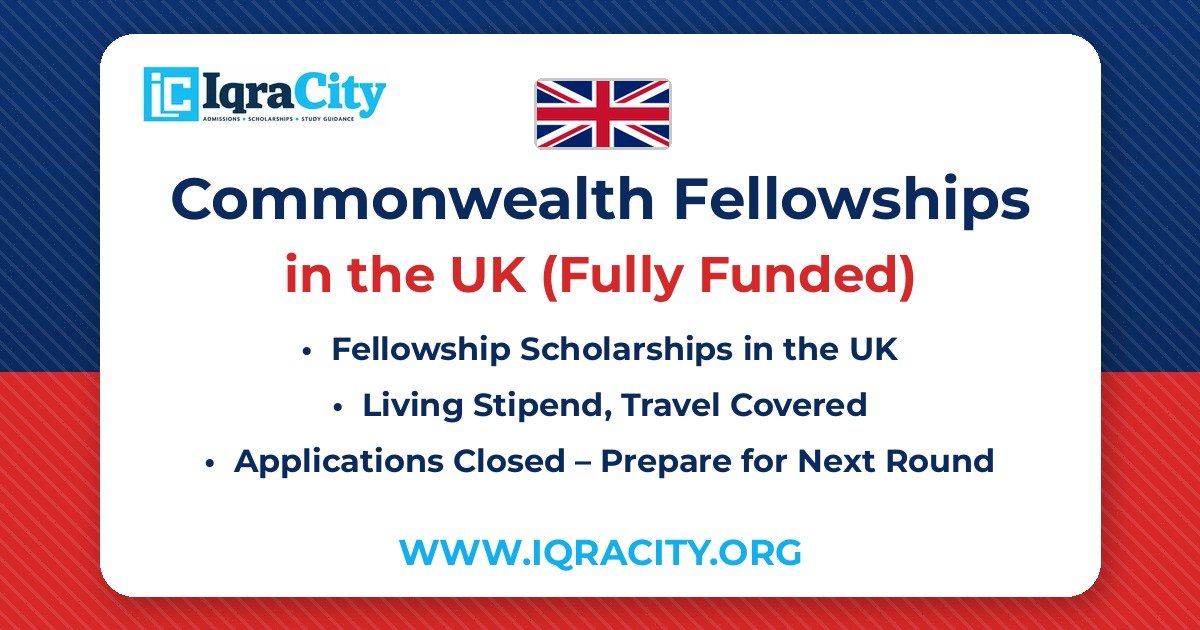
In short: The Commonwealth Fellowship Programme offers fully funded 6-week to 3-month fellowships in the UK for mid-career professionals (5+ years' experience) and university academics (PhD holders) from all Commonwealth countries. It covers return airfare, a £2,218/month stipend, and visa costs. Applications for 2027 opened 28 July and closed 16:00 BST on 25 August 2026 — use this guide to prepare for the 2028 round.
Quick Overview
- Host Country: United Kingdom
- Host Institution: UK host organisations — universities (Oxford, Imperial, UCL, Bath, Reading, Bradford, Strathclyde), NHS trusts, research institutes, and professional bodies
- Degree Level: Mid-career professionals and PhD-holding academics (no new degree involved)
- Program Duration: 6 weeks to 3 months (Professional); 3 months (Academic)
- Funding Type: Fully funded fellowship
- Deadline: The 2027 call is closed — applications ran 28 July to 25 August 2026 (16:00 BST). The 2028 call has not been announced yet.
Benefits of the Commonwealth Fellowships
The financial package is solid — you're fully supported for the whole stay:
- Return airfare — Approved return airfare from your home country to the UK.
- Monthly stipend — £2,218 per month (or £2,753 per month for those at organisations in the London metropolitan area), paid monthly for the duration of the award (2025/26 rates).
- Visa fee reimbursement — The standard visa application fee is reimbursed.
- Arrival allowance — Up to £1,247.09 on arrival, including an element for warm clothing.
- Professional development funds — Hosts can claim up to £1,000 for programmes of 6 weeks to 2 months, and up to £2,000 for 2–3 month programmes, to cover short courses, conferences, and travel to visit other UK organisations where these are integral to the programme.
- Disability support — Fellows who declare a disability receive a full assessment of needs and eligibility for additional financial support.
Eligibility Criteria for the Commonwealth Fellowships
The official criteria (from the CSC's information-for-candidates page):
- Nationality — Be a citizen of, or have been granted refugee status by, an eligible Commonwealth country, or be a British Protected Person. From 2026/27, candidates from all Commonwealth countries can apply; around 30 fellowships are earmarked for citizens of ODA-eligible countries and around 10 for non-ODA countries (e.g. Australia, Canada, Singapore, New Zealand, Malta).
- Residence — Be permanently resident in an eligible Commonwealth country. You must not have indefinite leave to remain in the UK.
- Professional Fellows — Have at least five years' full-time (or equivalent part-time) relevant work experience in a profession related to the fellowship programme, by the proposed start date. Note: voluntary work does not count toward the five years.
- Academic Fellows — Hold a PhD and be employed by a university in a Commonwealth country other than the UK.
- Current employment — Be in employment at the time of application at an organisation you will return to after completing the fellowship.
- References — Provide at least two references, one of which must be from your current employer. Applications without references are considered ineligible.
- No recent fellowship — Not have undertaken a Commonwealth Fellowship within the last five years (at the time of taking up the award).
- Availability — Be available to undertake the fellowship from the prescribed start date (Professional: begin mid-February to mid-March 2027; Academic: begin January/February 2027).
- Host-specific criteria — Meet any additional eligibility criteria set by your chosen host organisation, and check whether the host recruits from an established network — some do, so contact them before applying.
How to Apply for the Commonwealth Fellowships
Applications go through the CSC's online system (for 2027 this was CSC Central / the official application form):
1. Choose your host programme — Browse the host organisation programmes listed on the CSC page (for 2027 these included Oxford's Doctoral Training Centre, Imperial College London, UCL, the Royal College of Emergency Medicine, Justice Defenders, the British Geological Survey, and many others). Each host runs a bespoke programme with its own dates and theme. 2. Contact the host — If the host recruits from an established network (the CSC page flags this), contact them directly before applying to avoid a wasted application. 3. Prepare your development impact statement — The heart of the application, in four parts: how the fellowship relates to one of the six CSC development themes and development issues at global, national, and local levels (200 words); how you'll apply your new skills afterwards (100 words); expected development outcomes, timeframe, and beneficiaries (250 words); and how the impact will be measured (100 words). 4. Gather your references — At least two, one from your current employer. References must arrive or the application is ineligible. 5. Write your statements — A statement on the relevance of your previous work experience (300 words); your award objectives and how the programme meets them; your objectives for the next two years and the longer term; a personal statement on your background and impact drive (500 words); and a summary of voluntary activities and leadership (500 words). 6. List qualifications and publications — All university qualifications, plus up to ten publications and prizes (if applicable), and your employment history with relevance notes (100 words per job). 7. Submit the application form — Complete everything in the official online form before the deadline. For 2027, applications opened 9:00 BST on 28 July and closed at 16:00 BST on 25 August. The CSC accepts nothing outside this form. 8. After submission — Shortlisted candidates go through assessment on three criteria: quality and relevance of the programme, development impact, and candidate potential — followed by due-diligence checks before any award is confirmed.
Required Documents
Per the official CSC application form, you will need:
- Completed online application form (all sections, submitted within the window)
- Details of all undergraduate and postgraduate qualifications
- Up to ten publications and prizes (if applicable)
- Employment history with relevance explanations
- Statement on the relevance of previous work experience (up to 300 words)
- At least two references (one from your current employer)
- Development impact statement (four parts, as above)
- Award objectives, two-year objectives, and longer-term objectives
- Personal statement (up to 500 words)
- Voluntary activities and leadership summary (up to 500 words)
- Scan of your passport or national identity card
Commonwealth Fellowships Deadline
Applications for the 2027 Commonwealth Fellowships opened at 9:00 BST on Tuesday 28 July 2026 and closed at 16:00 BST on Tuesday 25 August 2026 — the call is now closed. Professional Fellowships will run between mid-February and mid-March 2027 (6 weeks to 3 months), and Academic Fellowships begin in January/February 2027 (3 months).
If you missed the window, plan for the next cycle: the programme is annual, and the application window is short (about four weeks), so the smart move is to identify your host programme and start drafting your development impact statement now — it's the section where most strong applications win or lose.
Frequently Asked Questions
Is the Commonwealth Fellowship really fully funded?
Yes. Each fellowship provides approved return airfare, a monthly stipend of £2,218 (£2,753 in London), visa fee reimbursement, an arrival allowance of up to £1,247.09, and up to £1,000–£2,000 in professional development funds for courses and conferences integral to the programme. There are no tuition-style fees — the programme is hosted, not studied.
Who is eligible — do I need a PhD?
Only for the Academic Fellowship strand, which requires a PhD and university employment in a Commonwealth country outside the UK. The Professional Fellowship strand is for mid-career professionals with at least five years' relevant work experience — no PhD required.
Which countries are eligible?
From 2026/27, citizens of all Commonwealth countries can apply. Around 30 fellowships are reserved for citizens of ODA-eligible countries (including Pakistan, India, Nigeria, Kenya, Bangladesh, Ghana) and around 10 for non-ODA Commonwealth countries (including Australia, Canada, Singapore, New Zealand, and Malta).
I'm self-employed. Can I still apply?
Yes, with a nuance on references: the CSC requires at least two references, and one must normally be from your current employer — unless you are self-employed, in which case that requirement is adapted. You must still be working and intend to continue in your field after the fellowship.
Can I choose any UK university or organisation?
No. You apply to specific host programmes that have been selected by the CSC for that year's cycle — the 2027 list included Oxford, Imperial, UCL, Bath, Reading, Bradford, Strathclyde, NHS trusts, and professional bodies. Each runs a bespoke programme with set dates and a priority development theme.
How are fellows selected?
Applications are assessed on the quality and relevance of the proposed programme, development impact, and candidate potential. Your development impact statement (four parts) and the relevance of your experience carry the most weight.
Can I apply if I've had a Commonwealth Fellowship before?
Not if it was within the last five years. Anyone who undertook a Commonwealth Fellowship more than five years before taking up the new award is eligible again.
What visa do fellows need?
Commonwealth Professional Fellows require a Temporary Work – Government Authorised Exchange (GAE) visa; the ACU (which provides the CSC Secretariat) acts as visa sponsor and assigns the Certificate of Sponsorship. Academic Fellows also use the Temporary Work – GAE route, with the academic host acting as sponsor.
Can I travel outside the UK during the fellowship?
Fellowships are tenable in the UK only. Travel outside the UK requires permission from your CSC Programme Officer and host, granted only in exceptional circumstances.
When will the 2028 applications open?
The 2028 dates had not been announced at the time of writing. The 2027 cycle opened in late July and closed in late August 2026 — a similar July/August window is likely for 2028. Check the official CSC page regularly.
Final Words
The Commonwealth Fellowship Programme is built for people who've already started making a difference at home and want world-class exposure to multiply that impact. The 2027 window was brief — just four weeks — which is exactly why preparing early matters so much. Pick your host programme, start your impact statement, and line up your references now.
Related Scholarships
More opportunities you may also qualify for:
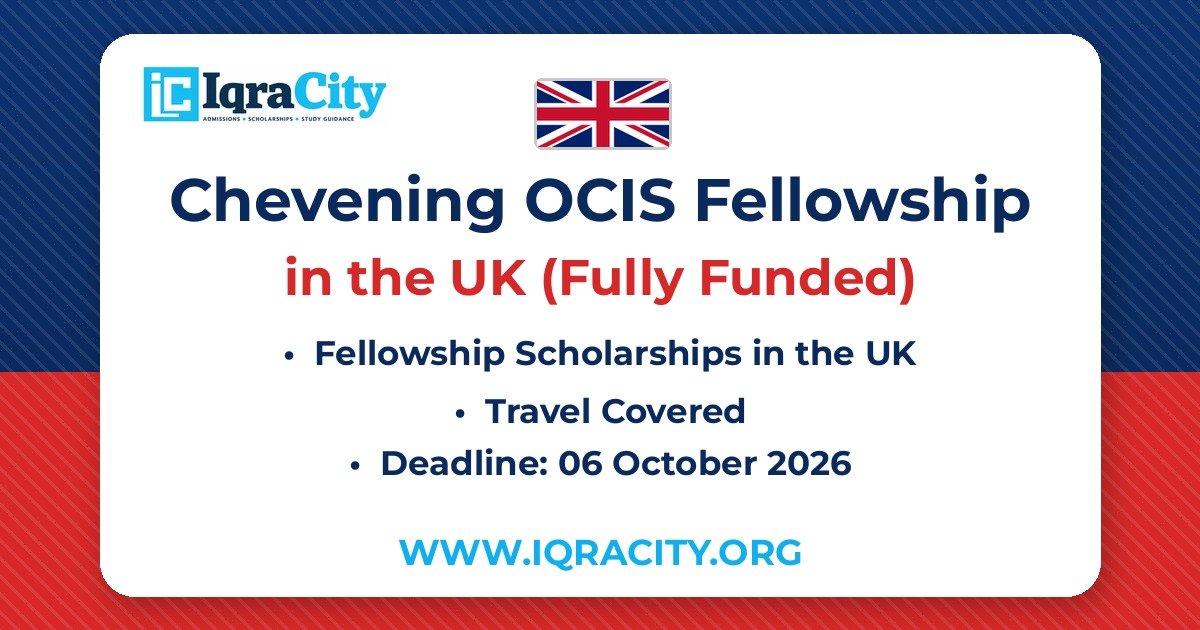
- Chevening OCIS Fellowship 2027 in the UK | Fully Funded to Oxford · UK • Fully Funded
- Cambridge ERA AI Fellowship 2027 in UK | Fully Funded · UK • Fully Funded
- Chevening LSE Fellowship 2027 in the UK | Fully Funded · UK • Fully Funded
- Chevening British Library Fellowship 2027 in the UK | Fully Funded · UK • Fully Funded