

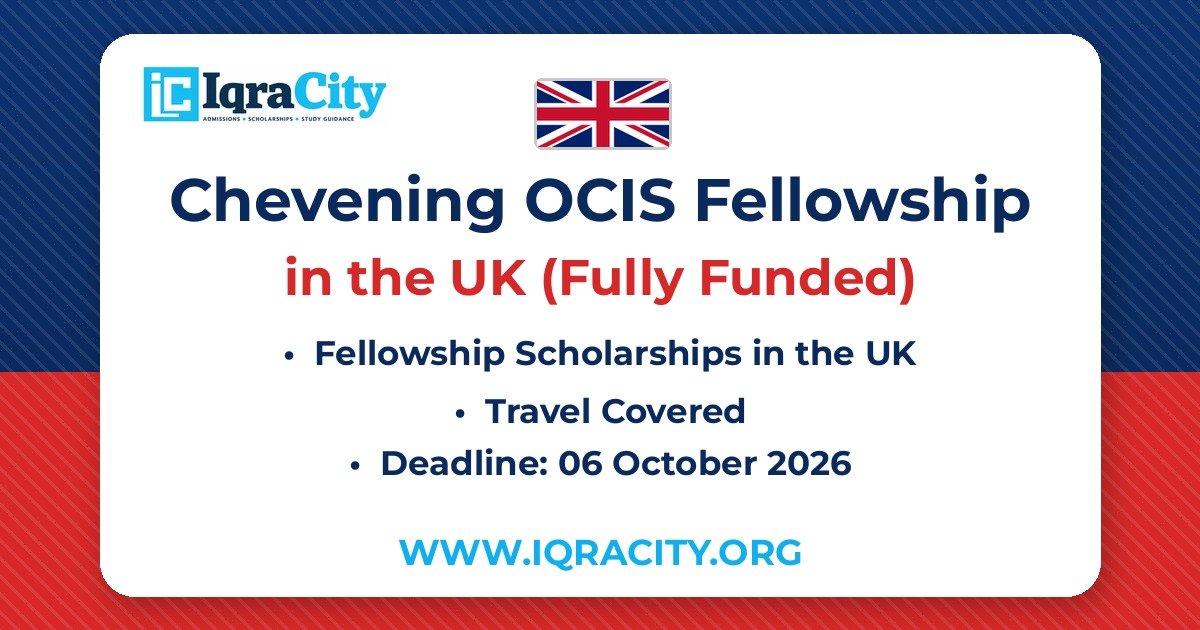
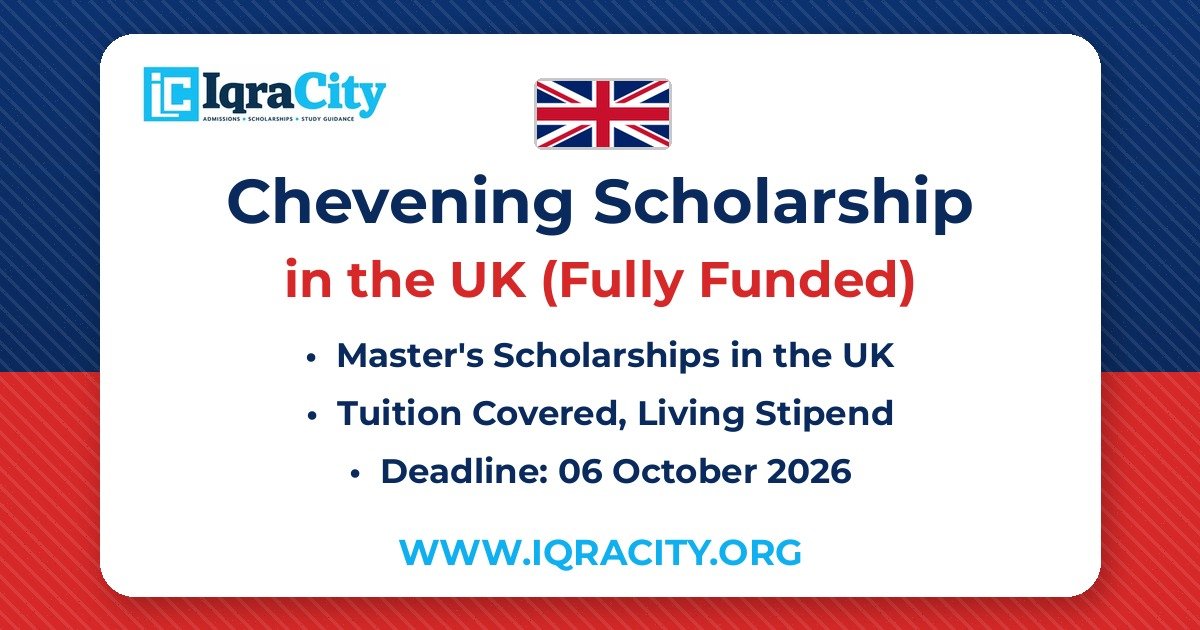
Chevening is the UK government's flagship scholarship, run by the Foreign, Commonwealth & Development Office, and it funds a full one-year taught master's degree in the United Kingdom for future leaders from more than 160 countries and territories — Pakistan very much included. It is genuinely fully funded: tuition, a monthly living stipend, flights, and even your visa cost are covered. Applications for the 2027/28 cohort opened on 4 August 2026 and close on 6 October 2026 at 11:00 UTC — if you're reading this with days to spare, you still have time, but the clock is genuinely ticking.
In short: Chevening is the UK government's fully funded one-year master's scholarship for emerging leaders from eligible countries. (Chevening Application Guide 2027) You need an undergraduate degree, at least two years of work experience, and three eligible UK master's course choices. Applications close 6 October 2026 at 11:00 UTC — this is a step-by-step preparation guide for the 2027 cohort.
Quick Overview
- Host Country: United Kingdom
- Host Institution: Any eligible UK university (you choose your courses)
- Degree Level: One-year taught master's degree
- Program Duration: 12 months
- Funding Type: Fully funded by the UK government (FCDO)
- Deadline: 6 October 2026, 11:00 UTC
Benefits of the Chevening Scholarship
This is one of the rare scholarships that actually deserves the label "fully funded" — nothing meaningful is left to your own pocket:
- Full tuition coverage — your university fees are paid directly to your UK institution, whatever the course costs.
- Monthly living stipend — around £1,347 per month, adjusted depending on whether you live inside or outside London, enough to cover rent, food, and daily life.
- Return economy airfare — your flights to the UK and back home are booked for you.
- Visa cost covered — the cost of one UK student visa application is reimbursed.
- Arrival and departure allowances — lump sums to help you settle in and then return home.
- Travel grant for Chevening events — funding to attend the programme's networking events, workshops, and talks across the UK.
- Thesis and research grants — additional support for dissertation costs where your course requires it.
Eligibility Criteria for the Chevening Scholarship
Chevening is strict about eligibility — it's worth reading this list carefully before you invest hours in the application:
- Eligible nationality — you must be a citizen of a Chevening-eligible country or territory (Pakistan is eligible, with its own country page on chevening.org). You cannot be a British or dual British citizen, with narrow exceptions for certain overseas territories.
- Undergraduate degree — you need a bachelor's degree that would allow you to gain entry to a UK postgraduate programme. No specific GPA is published, but your academic record should convince the university, not just Chevening.
- Two years of work experience — at least 2,800 hours of eligible work experience completed after graduation. Chevening is unusually generous about what counts: full-time jobs, part-time work, internships, voluntary work, and even freelance or community work all qualify. You don't need all of it in one role.
- Three eligible master's courses — you must apply to three different eligible one-year taught master's courses at UK universities and receive an unconditional offer from at least one of them by 8 July 2027.
- Return-home commitment — you must be willing to return to your home country for a minimum of two years after your scholarship ends. This is a core condition, not a formality.
How to Apply for the Chevening Scholarship 2027
Everything happens online through the official Chevening application system. Here's the sequence, step by step:
1. Check your country's page first. Go to chevening.org, select Pakistan (or your country), and read the eligibility guidance — a few requirements differ by country. 2. Pass the eligibility checker. Before anything else, the portal runs you through an eligibility check. If you fail it, you can't proceed, so do this early rather than after weeks of drafting. 3. Create your account. Register on the online application system. You'll receive an access code — keep it safe, because you'll need it every time you log back in. 4. Fill in your personal, academic, and professional details. This is straightforward form-filling: education history, employment history, passport details. Be consistent with your documents. 5. Research and select three eligible master's courses. This is a strategic decision, not a formality. Pick courses that genuinely connect to your career plan — assessors will check whether your three choices tell a coherent story. Remember that Chevening only funds full-time, one-year taught master's programmes; MBAs with certain conditions, part-time, distance-learning, and PhD courses are excluded. 6. Write the four Chevening essays. The heart of your application. You answer four questions — on leadership and influence, on networking, on your career plan, and on why you've chosen your three courses in the UK. Each has a short word limit (check the current form), so every sentence has to earn its place. Use specific examples from your own life, not generic statements about wanting to help the world. 7. Apply separately to your chosen universities. The Chevening application is not a university application. You must apply to the three universities independently, on their own timelines, so you can secure an unconditional offer from at least one by 8 July 2027. 8. Review everything and submit well before 6 October 2026, 11:00 UTC. The portal shuts down to the minute — no late submissions, no exceptions. Aim to submit at least 48 hours early. 9. If shortlisted, attend the interview. Shortlists are announced around February 2027. Interviews happen at the British embassy or high commission in your country (in Pakistan, that's the British High Commission in Islamabad), usually between March and May 2027. 10. Secure your unconditional offer by 8 July 2027, 17:00 BST. If you don't have one from at least one of your three chosen courses, you can't take up the scholarship.
Required Documents
At the application stage, Chevening mostly wants information, not a mountain of uploads — documents come into play later in the process. Prepare these:
- Valid passport (biographical details page)
- Undergraduate degree certificate and academic transcripts
- Updated CV or resume detailing your work history
- Details of three chosen UK master's courses (university names, course titles)
- Two references — academic or professional (these are requested if you progress; don't wait until the last minute to brief your referees)
- Proof of work experience (appointment letters, experience certificates, payslips — Chevening may ask for evidence backing your stated hours)
- Your four essay answers, drafted and proofread
Chevening Scholarship 2027 Deadline
Applications for Chevening 2027/28 close on 6 October 2026 at 11:00 UTC. That is the hard, minute-precise cut-off — the portal simply becomes inaccessible afterwards. After that: reading committees assess applications from October 2026 to January 2027, shortlists are announced around mid-February 2027, interviews run March to May 2027, results come out in June 2027, and successful scholars arrive in the UK in September or October 2027 to begin their degrees.
If you miss this deadline, there is no appeal and no late route — you wait for the next annual round, which typically opens each August.
Frequently Asked Questions
Is the Chevening Scholarship really fully funded?
Yes — properly fully funded. Tuition is paid in full, you receive a monthly stipend of around £1,347, your return flights and one visa application are covered, and arrival and departure allowances plus event travel grants are included. You are not expected to contribute your own savings.
Who can apply for Chevening from Pakistan?
Pakistani citizens are eligible — Pakistan has one of the largest Chevening applicant pools in the world. You need an undergraduate degree, at least 2,800 hours of post-graduation work experience, and you must not hold British or dual British citizenship.
What work experience counts toward the 2,800 hours?
Far more than most people expect: full-time and part-time jobs, internships, voluntary work, freelance and consulting work, and community or political work all count, as long as it was done after graduation. You don't need all the hours from a single employer.
Do I need IELTS or another English test for Chevening itself?
No — Chevening does not require an English test during the scholarship application. However, your chosen UK universities will have their own English requirements, and you need an unconditional offer from one, so check each university's language policy early.
How competitive is Chevening?
Very. Thousands apply for a limited number of awards each year across 160+ countries and territories. The differentiator is almost never grades alone — it's a convincing leadership story and a clear plan for what you'll do with the degree back home.
Can I apply for an MBA or a PhD through Chevening?
Chevening funds one-year taught master's degrees. Certain MBA programmes are eligible under specific conditions (check the official guidance for the current year), but PhDs, part-time, and distance-learning courses are not.
What if I only get an offer from one of my three courses?
That's fine — you only need an unconditional offer from one of your three chosen courses by the 8 July 2027 deadline. You can't substitute in a fourth course you didn't list on your application, though.
Can I change my course choices after submitting?
Not casually. Your three courses are locked into your application, so choose them carefully. If your circumstances genuinely change, contact Chevening directly — but don't count on being allowed to swap.
Do I need to secure university admission before the 6 October deadline?
No. The Chevening application and the university applications run in parallel but separately. You apply for Chevening by 6 October 2026, and you have until 8 July 2027 to secure an unconditional offer from one of your three listed courses.
What happens after I submit my application?
Independent reading committees assess all eligible applications from October 2026 to January 2027. Shortlisted candidates are invited to interview at their local British embassy or high commission (March–May 2027), and final results are announced in June 2027. Only shortlisted candidates are contacted for interviews, so plan your university applications regardless.
Final Words
Chevening rewards people who can show, not just say, that they're going somewhere — the essays are where applications are won or lost, so spend most of your preparation time there rather than polishing your CV. With the deadline days away, prioritise a complete, honest, submitted application over a perfect-but-missed one. You can refine your course applications afterwards; you can't get the portal back once it closes.
Related Scholarships
More opportunities you may also qualify for:
- Marshall Scholarship 2027 in UK | Fully Funded Study for Americans · UK • Fully Funded
- Scotland Pakistan Scholarships 2026 for Young Women and Girls | Fully Funded · UK • Fully Funded
- How to Prepare Your Chevening Scholarship Application 2027 (Step-by-Step Guide) · UK • Fully Funded
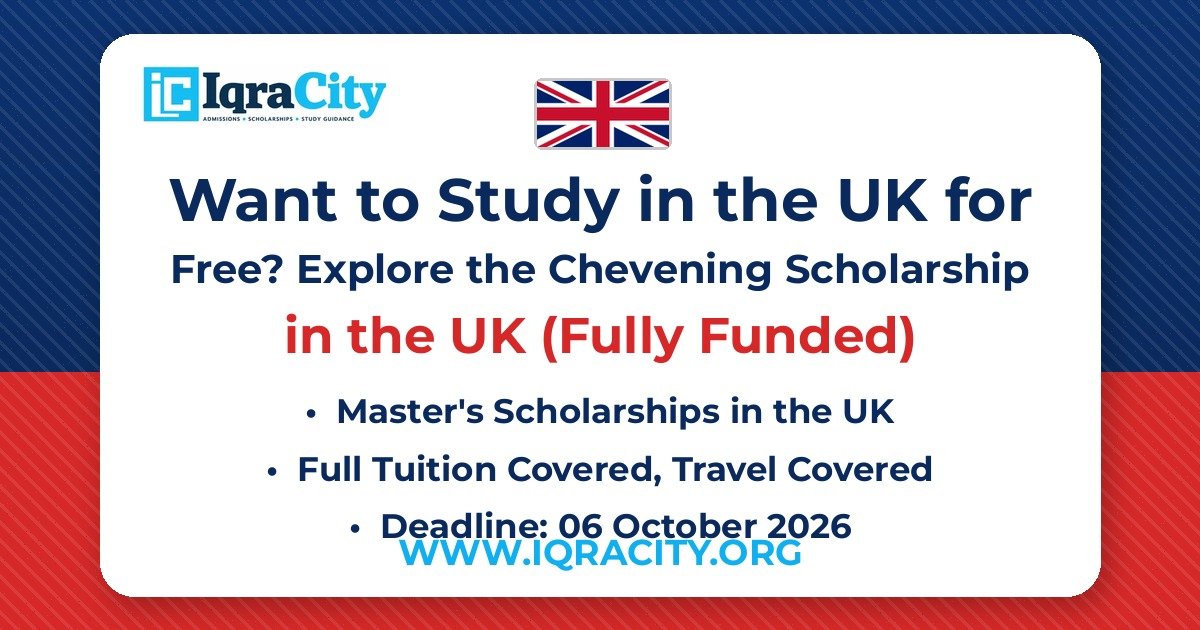
- Want to Study in the UK for Free? Explore the Chevening Scholarship · UK • Fully Funded

2 comments on “How to Prepare Your Chevening Scholarship Application 2027 (Step-by-Step Guide)”