

If you're from a developing country and dreaming of a world-class degree in Australia without paying a cent, the Australia Awards Scholarship is the one to know about. Funded by the Australian Government through the Department of Foreign Affairs and Trade (DFAT), it covers tuition, flights, living costs, and health insurance for bachelor's, master's, and PhD study. It's competitive — thousands apply every year — but it's also one of the most generous scholarships on the planet.
In short: The Australia Awards Scholarship is a fully funded Australian Government award for citizens of participating developing countries across Africa, Asia, the Pacific, and the Middle East. The 2027 intake opened 1 February 2026 and closed 30 April 2026, so the next chance is the 2028 intake, expected to open around February 2027.
● Applications Closed
Quick Overview
- Host Country: Australia
- Host Institution: Participating Australian universities and institutions
- Degree Level: Bachelor's, Master's, PhD (varies by country)
- Program Duration: Full duration of the approved program
- Funding Type: Fully funded (tuition + living + travel + health cover)
- Deadline: 30 April 2026, 14:00 AEST (2027 intake — now closed; 2028 intake dates not yet announced)
Benefits of the Australia Awards Scholarship
This is a genuine full ride. Here's what the Australian Government typically covers for its scholars:
- Full tuition coverage — Your entire university tuition fees are paid, from day one to graduation.
- Return airfare — A return economy-class ticket between your home country and Australia, arranged for you.
- Establishment allowance — A one-off payment when you arrive to help with accommodation, textbooks, and study materials.
- Living expenses — A fortnightly Contribution to Living Expenses (CLE), set at a rate DFAT determines, to cover your basic costs while you study.
- Introductory Academic Program — A preparatory program before your degree starts, covering what living and studying in Australia is actually like.
- Health insurance — Overseas Student Health Cover (OSHC) for the whole scholarship period, so medical costs don't eat into your budget.
- Pre-course English training — If your English needs a boost before the degree begins, this can be included.
- Supplementary academic support — Extra tutoring or academic help if you need it during your studies.
- Fieldwork allowance — For eligible research students (and some coursework master's students with a compulsory research component) who need to do fieldwork.
Exact entitlements can vary slightly by country and award conditions, so always check your own country's profile. But the core promise holds: you won't be paying tuition, rent out of pocket, or flight costs.
Eligibility Criteria for the Australia Awards Scholarship
The rules are country-specific — this is the part people skip and then get rejected over. The general requirements are:
- Citizenship — You must be a citizen of a participating country. If you hold Australian citizenship or permanent residency, you're out.
- Development alignment — Your chosen field of study must line up with your home country's development priorities (usually listed in your country profile — think health, agriculture, energy, public policy).
- Academic readiness — You need the qualifications for the level you're applying to: completed secondary school for a bachelor's, a bachelor's degree for a master's, and so on.
- Leadership and commitment — They're investing in future leaders, not just good students. Evidence of professional experience, community involvement, or leadership potential matters.
- Return-home commitment — You must agree to return to your home country for a minimum of two years after finishing. This is a hard condition, not a suggestion.
- No double-dipping on levels — You can't apply for a qualification at the same or lower level than one you already hold.
- AI honesty — DFAT is strict about this: you may use AI for basic help like spelling, grammar, or organizing your ideas, but AI must not write, improve, or paraphrase your application responses. Misuse can get you disqualified.
Always read your country's profile on the official site before anything else — it lists the exact eligibility, priority fields, and documents for your nationality.
How to Apply for the Australia Awards Scholarship
1. Find your country profile. Go to the official Australia Awards website and select your country of citizenship. Read every line — this is your rulebook. 2. Check the priority fields. Confirm your intended degree matches your country's development priorities and that your study level (bachelor's, master's, PhD) is offered. 3. Take your English test early. Many countries require an English proficiency score. Book it months ahead; don't leave it to the last week. 4. Gather your evidence. Line up academic transcripts, referee reports, employment letters, and anything else your profile demands. Scan everything in colour, in the right order. 5. Write your own story. Your application responses must be original. Connect your chosen field to a real development challenge back home — generic answers get cut early. 6. Apply through OASIS. Submit online via the Online Australia Scholarships Information System (OASIS). If you genuinely can't access it, hardcopy applications by mail are accepted in some cases. 7. Finalise before the deadline. In OASIS, a saved-but-not-submitted application counts for nothing. Finalise and submit well before closing time. 8. Wait for shortlisting. Only shortlisted applicants are contacted — usually for an interview or to provide more information.
Required Documents
The exact list comes from your country profile and the Australia Awards Scholarships Policy Handbook, but most applicants need:
- Academic transcripts and degree certificates (colour scans, legible, in order)
- Referee reports from academic or professional referees
- Proof of employment and work experience, where required
- English language test results, if your country profile requires them
- Valid passport (or national ID where accepted)
- Proof of residency, for some countries
- Any country-specific forms, such as endorsement letters or development impact statements
Compile documents into single PDFs by category, name the files clearly, and upload everything before the closing date. Late documents are not considered.
Australia Awards Scholarship Deadline
Here's the honest picture: the 2027 intake is finished. Applications opened on 1 February 2026 and closed on 30 April 2026 (14:00 AEST), and late applications were not accepted. If you missed it, don't wait around hoping for an extension — there won't be one.
The next round is the 2028 intake. Official dates hadn't been announced at the time of writing, but the program has run on a steady February-to-April rhythm for years, so expect applications to open around February 2027. Start preparing now: English test, transcripts, referees, and a clear development-impact story. The people who win this scholarship are usually the ones who started six months early.
Frequently Asked Questions
Is the Australia Awards Scholarship really fully funded?
Yes. It's one of the few scholarships that genuinely covers the big four: full tuition, return airfare, living expenses, and health insurance. You also get an establishment allowance on arrival and academic support along the way. Individual entitlements can vary by country, so check your country profile for the fine print.
Which countries are eligible for Australia Awards?
Citizens of participating developing countries across Africa, Asia, the Pacific, and the Middle East can apply — including Nigeria, Ghana, Kenya, Pakistan, Bangladesh, Indonesia, the Philippines, Vietnam, Fiji, and Papua New Guinea, among many others. The list can change between intakes, so verify your country on the official participating-countries page.
Can I apply for a bachelor's degree, or only postgraduate?
Both, depending on your country. Australia Awards covers bachelor's, master's, and PhD study, but not every country offers every level. Your country profile states exactly which study levels are open to you.
Do I need an IELTS score to apply?
It depends on your country. Many country profiles require proof of English proficiency, and postgraduate applicants commonly need something around IELTS 6.5 overall. Check your profile early and book your test with time to spare.
Can I stay in Australia after finishing my degree?
No — that's the deal. You commit to returning to your home country for at least two years after completing the scholarship. The program exists to build skills in developing countries, not to create a migration pathway.
Can I use AI to help write my application?
Only in a very limited way. DFAT allows AI for basic tasks like checking spelling and grammar or organizing your ideas. It must not be used to write, improve, or paraphrase any part of your application. Breaking this rule can lead to disqualification.
What if I miss the deadline?
You're out for that intake — late applications and supporting documents are not considered, no exceptions. Mark the closing date in your calendar and aim to submit at least a week early in case of technical issues.
Can I reapply if I was rejected before?
Yes, there's no ban on reapplying in a later round. Many successful scholars applied more than once. Use the extra year to strengthen your weak spots: better English scores, clearer development-impact narrative, stronger referees.
Do I need to find a university or supervisor before applying?
No. Unlike some research scholarships, you don't need prior university admission to submit your Australia Awards application. You list your preferred courses and institutions in the application itself.
How competitive is it, honestly?
Very. Thousands of strong candidates apply from each region every year. What separates winners isn't just grades — it's a convincing, specific plan for how your degree will help solve a real problem back home. Generic applications don't survive the first cut.
Final Words
The Australia Awards Scholarship is about as good as it gets: a full ride to study in Australia, backed by one of the most respected development programs in the world. The 2027 round has closed, but the 2028 intake is on the horizon — and the winners of that round are already preparing. Check your country profile, get your English test done, and start shaping your story now.
Related Scholarships
More opportunities you may also qualify for:
- Melbourne Graduate Research Scholarships 2027–28 in Australia (Fully Funded) · Australia • Fully Funded
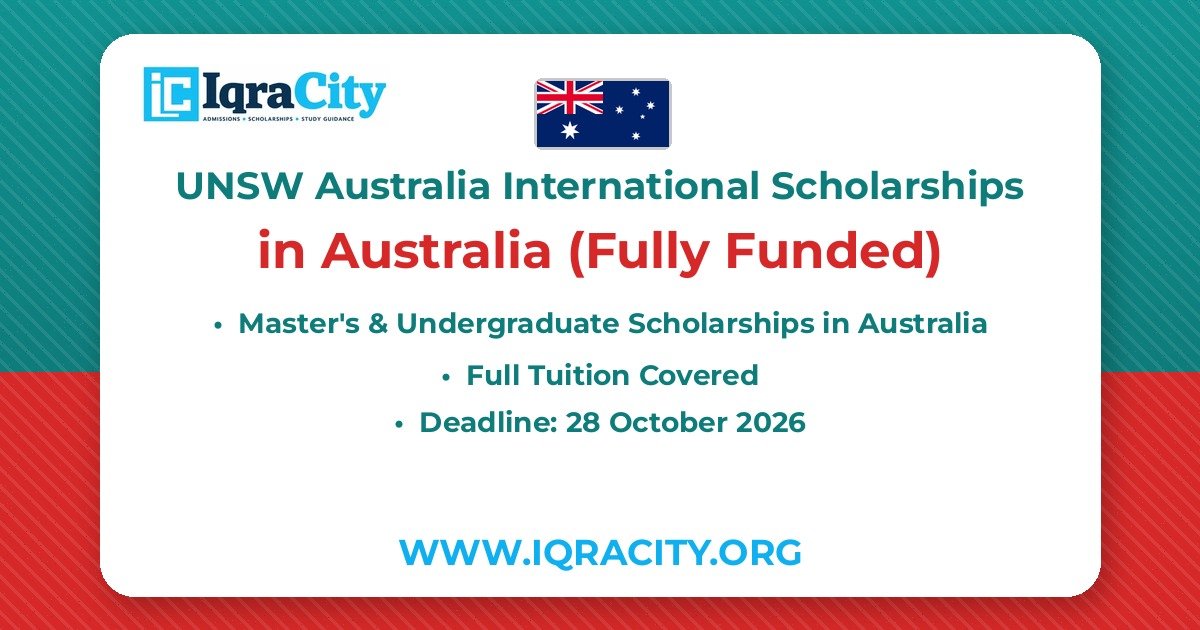
- UNSW Australia International Scholarships 2027 · Australia • Fully Funded
- ANU RTP Scholarship 2027: Study at Australia's Top Research University Fully Funded · Australia • Fully Funded
- University of Melbourne RTP Scholarship 2027 in Australia (Fully Funded) · Australia • Fully Funded





















2 comments on “Australia Awards Scholarship 2027 | Fully Funded Study in Australia”