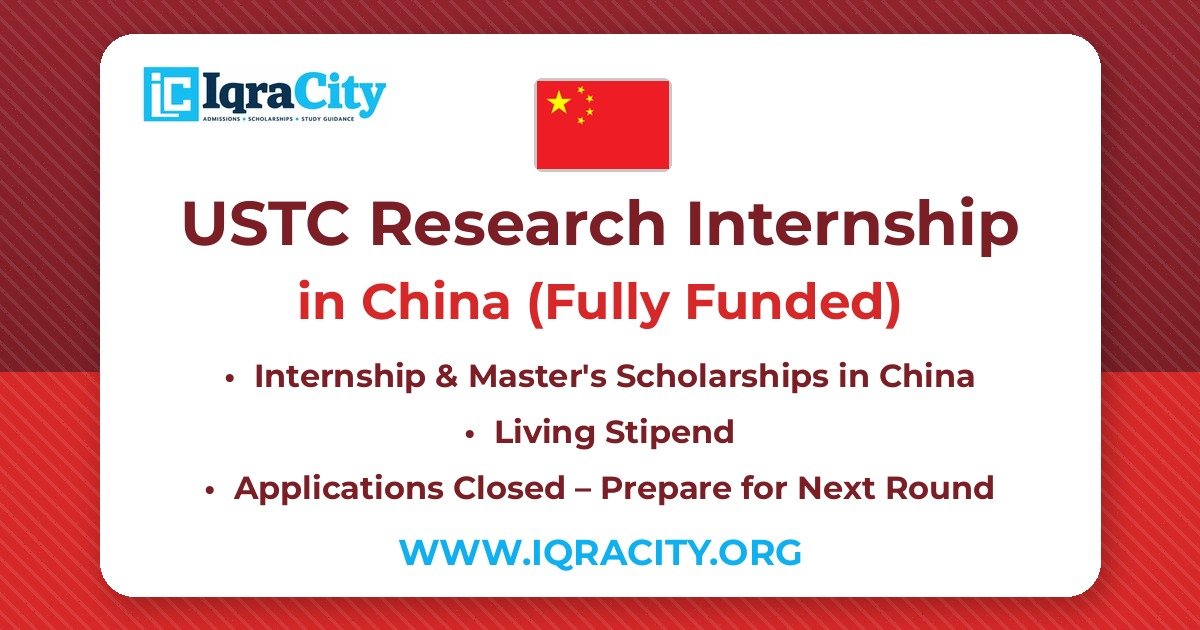
If you've ever wanted to do real research at one of China's strongest science universities — and get paid for it — this is your moment. The University of Science and Technology of China (USTC) runs an international research internship that places students inside actual laboratories under the guidance of USTC professors. The top fellowship tier covers your tuition, dormitory, insurance, and pays a monthly stipend of up to 3,500 RMB. Here's the catch worth knowing today: the application window for the fully funded Level A fellowship closes on 30 September 2026 — which is right now.
In short: USTC's Research Internship 2027 is a 3-to-12-month, full-time research placement in Hefei, China, open to third- and fourth-year undergraduates, master's students, and PhD students from anywhere in the world except China. Level A fellows get everything covered plus a monthly stipend. The spring 2027 intake deadline for Level A is 30 September 2026.
● Applications Closed
Quick Overview
- Host Country: China
- Host Institution: University of Science and Technology of China (USTC), Hefei
- Degree Level: Bachelor's (Year 3/4), Master's, PhD (must be currently enrolled)
- Program Duration: 3 months to 1 year
- Funding Type: Funded — three fellowship levels (A, B, C) plus self-funded option
- Deadline: Level A (Spring 2027 intake): 30 September 2026; Level B/C or self-funded: at least 3 months before your start date
Benefits of the USTC Research Internship
USTC splits its funding into three tiers, so the honest answer is that "fully funded" applies to Level A. Every applicant is evaluated for the fellowship levels, so here's exactly what each one gives you:
- Level A — the full package — Tuition fully waived, comprehensive medical insurance, free university dormitory, plus a monthly stipend: 2,500 RMB for bachelor's students, 3,000 RMB for master's students, and 3,500 RMB for PhD students.
- Level B — solid middle ground — Tuition waiver, comprehensive medical insurance, and free university dormitory, but no monthly stipend.
- Level C — tuition only — A tuition waiver for students who can arrange their own living costs.
- Lab experience that actually counts — You work on real research projects in state-of-the-art laboratories under USTC professors, which is the kind of line that makes a master's or PhD application stand out.
- A head start on future degrees — USTC says it plainly: interns build relationships with faculty and students, which gives you a genuine edge when applying for master's, PhD, or postdoctoral programs at the university later.
- Free Chinese language and culture classes — You can learn basic Chinese and explore the local Hui culture of Anhui province alongside your research.
- No application fee — Applying costs you nothing.
To put the stipend in perspective: 2,500–3,500 RMB a month roughly covers a comfortable student lifestyle in Hefei (it is not Beijing or Shanghai pricing), and your dormitory is free on top of it, so Level A is a genuinely comfortable package rather than a symbolic one.
Eligibility Criteria for the USTC Research Internship
- Non-Chinese citizenship — You must hold a valid foreign passport. Chinese nationals are not eligible for this international program.
- Age 18 to 40 — You must fall in this range when you apply.
- Currently enrolled full-time — You must be a third- or fourth-year undergraduate, a master's student, or a doctoral student. This is important: first- and second-year undergraduates and already-graduated students don't fit this call.
- Good health — You need to be in good physical and mental health for the stay.
- Clean record — No criminal convictions.
- Good command of English — The program is run in English, so you need to be able to work, read, and communicate in it.
- Any nationality, any field of science and beyond — The internship spans chemistry and materials science, computer science, life sciences, engineering, physics, mathematics, information science, management, humanities and social sciences, and more. If USTC has a lab in your field, there's a place for you.
How to Apply for the USTC Research Internship
1. Browse USTC professors in your field first — Before you touch the form, look through USTC's schools and supervisor profiles. Many successful applicants reach out to a professor beforehand to discuss a possible research match, and it strengthens your study plan considerably. 2. Open the online application — Go to the International College's application portal through the official Research Internship Program page (link at the bottom of this article). 3. Register and choose the right track — Select Non-degree program → Research Internship. This single step is where most wrong-track applications come from, so double-check it. 4. Complete the application form — Fill in your personal details, education history, intended duration (3–12 months), and proposed research area. Fields marked with an asterisk are mandatory. 5. Upload your documents — Passport copy, CV, certificate of enrollment, study plan, transcripts, and at least one recommendation letter (details below). 6. Submit and wait — You'll hear back on the fellowship decision. If admitted, you'll be asked to pay any applicable tuition online (zero for Level A/B/C), after which your official admission documents arrive by email. Then comes the JW201/JW202 visa form and your student visa application.
Required Documents
Only gather what the official application asks for — a bloated file won't help you:
- Photocopy of your passport — Ordinary passport, valid for at least one more year.
- Curriculum Vitae (CV) — Keep it research-focused: projects, publications, lab skills, awards.
- Certificate of enrollment — Proof that you're currently enrolled full-time in your degree program.
- Study plan — Your proposed research direction at USTC. This is the document that decides whether a professor wants you, so write it specifically, not generically.
- Transcripts for your highest degree — Official academic records.
- At least one recommendation letter — From a full professor or associate professor, including their phone number and email address.
- Notarized translations — Any document not in Chinese or English needs a notarized translation into one of the two.
USTC Research Internship Deadline
The Level A fellowship window for the spring 2027 intake runs from 1 July to 30 September 2026 — and since today is 30 September, this is genuinely the last day. If you're reading this late, don't panic: the fall semester Level A window opens 1 January to 31 March each year, so you can target the next intake instead. Applicants going for Level B, Level C, or the self-funded route don't face a fixed window — but you must complete your online application at least three months before the date you want to start at USTC. Missing the Level A window means missing the stipend, so time your application around it deliberately.
Frequently Asked Questions
Is the USTC Research Internship really fully funded?
Yes — if you're awarded the Level A fellowship. That tier covers your tuition, dormitory, medical insurance, and pays a monthly stipend of 2,500 to 3,500 RMB depending on your degree level. Level B covers everything except the stipend, and Level C covers tuition only, so "fully funded" describes Level A specifically.
Who can apply for the USTC Research Internship?
Non-Chinese citizens aged 18–40 who are currently enrolled full-time as third- or fourth-year undergraduates, master's students, or doctoral students. You need a valid foreign passport, good health, no criminal record, and a good command of English.
Can first- or second-year undergraduates apply?
No. The official eligibility requires you to be in your third or fourth year of a bachelor's program (or enrolled in a master's or PhD). If you're earlier in your studies, wait a year and apply then.
How long does the internship last?
Anywhere from 3 months to a full year. You choose your duration within that range when you apply — shorter stays suit summer or semester breaks, longer ones suit a genuine research immersion.
Do I need to speak Chinese?
No. The program requires a good command of English, not Chinese. You'll also get access to free basic Chinese language and culture classes during your stay, which is a nice bonus rather than a requirement.
What are the real costs if I'm not on a fellowship?
Tuition is 2,160 RMB per month for bachelor's and master's students (2,660 RMB for PhD students), dormitory rooms run 500–1,000 RMB per month, and insurance is 160 RMB per month. That's worth knowing if you're considering the self-funded route.
Do I need a supervisor's approval before applying?
The official document list doesn't require a pre-acceptance letter, but your study plan should align with a USTC professor's research. Reaching out to a potential supervisor before applying is widely reported to improve your chances — and it makes your study plan far more convincing.
What visa do I need?
A Chinese student visa (X visa). After admission, USTC sends you the JW201 or JW202 form plus your admission notice, which you take to the Chinese embassy or consulate. Your visa must stay valid for your entire stay.
Where will I live?
Level A and Level B fellows get on-campus accommodation on a first-come, first-served basis. If the dorms are full, or if you're on Level C or self-funded, you'll arrange off-campus housing yourself (and register with the local police station if you live off campus, as Chinese regulations require).
Can this internship lead to a degree at USTC later?
That's one of its stated purposes. Interns build relationships with faculty and get insider knowledge of the university, which the program describes as giving you a competitive edge in future master's, PhD, and postdoctoral applications at USTC.
Final Words
A paid research stint at a university of USTC's caliber — with housing, insurance, and a stipend handled — is the kind of experience that quietly changes the trajectory of an academic career. The Level A window closes today, so if your documents are ready, don't overthink it. And if you miss it, the January window gives you three months to craft an even stronger study plan. Either way, start here:
Related Scholarships
More opportunities you may also qualify for:
- Yenching Academy Scholarship 2027 in China | Fully Funded · China • Fully Funded
- Marshall Scholarship 2027 in UK | Fully Funded Study for Americans · UK • Fully Funded
- GEM Fellowship Program 2027 in USA | Fully Funded STEM Fellowship · USA • Fully Funded
- Melbourne Graduate Research Scholarships 2027–28 in Australia (Fully Funded) · Australia • Fully Funded