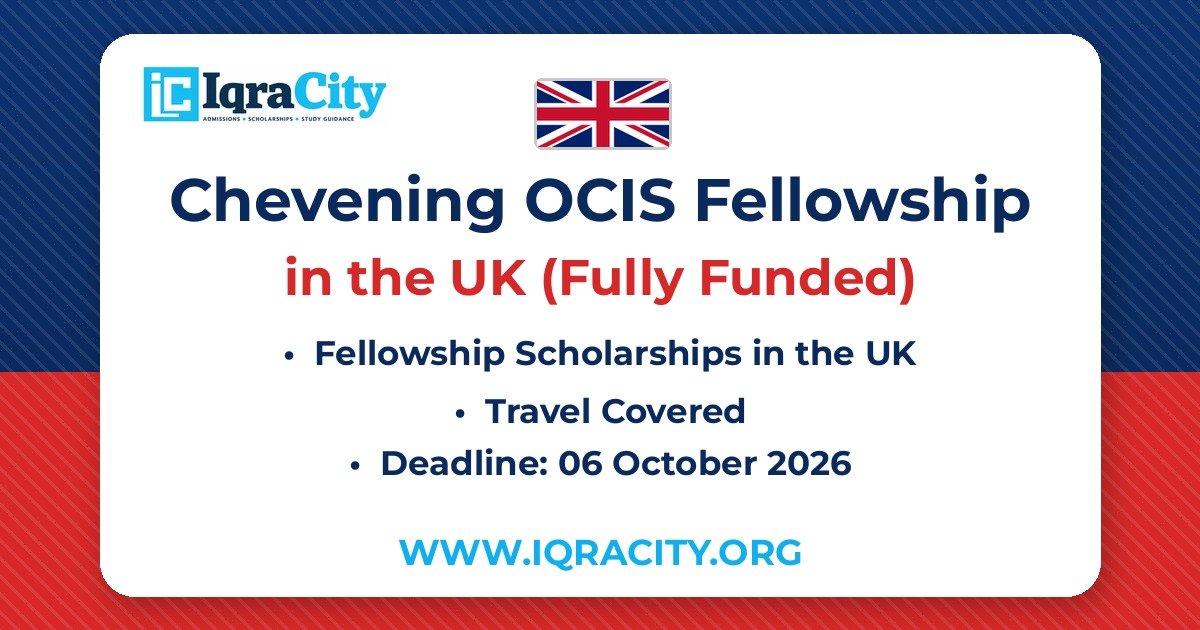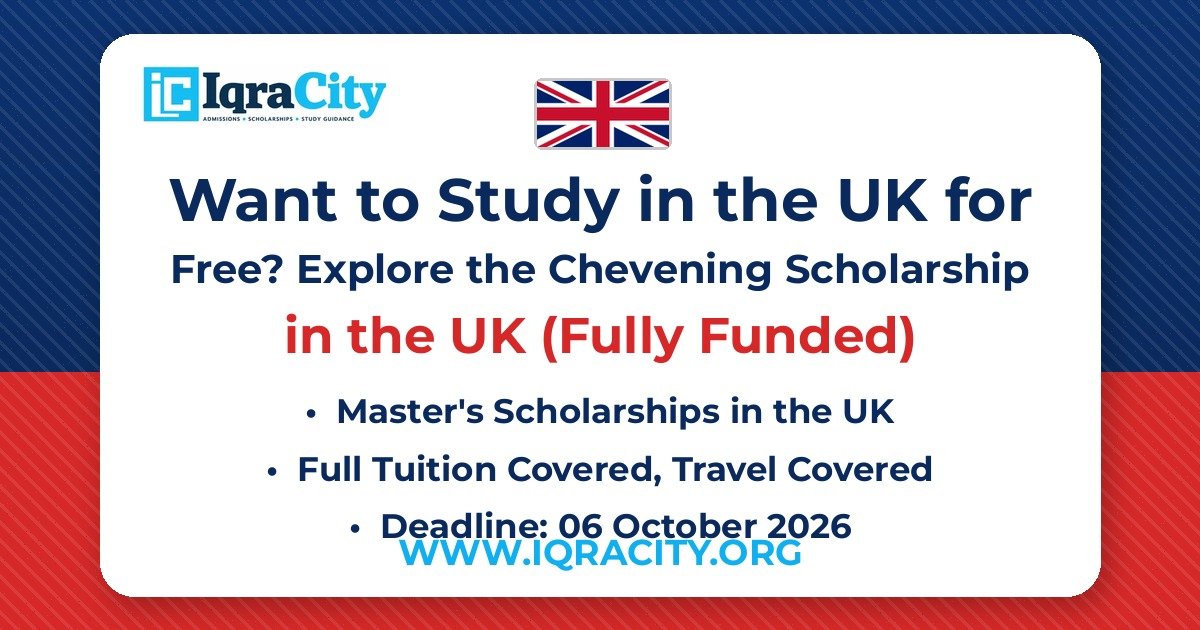
The Chevening Scholarship is the UK government's fully funded master's scholarship — tuition, living stipend, flights and visa all covered. For the 2027/28 round, applications opened on 4 August 2026 and the portal closes on 6 October 2026 at 11:00 UTC. That leaves roughly two months to get everything right — and with Chevening, "right" means far more than a tidy CV. Here is a practical plan for what the selection committees actually score.
In short: Chevening 2027 applications close 6 October 2026 at 11:00 UTC. (How to Prepare Chevening Scholarship Application 2027) You need four 500-word essays, 2,800+ work hours, three eligible UK master's course choices, and two referees. Start your essays and course research now.
Quick Overview
- Host Country: United Kingdom
- Host Institution: Any eligible UK university (you choose three courses)
- Degree Level: One-year taught master's degree
- Program Duration: 9–12 months
- Funding Type: Fully funded
- Deadline: 6 October 2026, 11:00 UTC (check your local time conversion)
Benefits of the Chevening Scholarship
Before you invest weeks in the application, know exactly what you are competing for:
- Full tuition fees — Covered for a one-year taught master's. Note: MBA tuition is capped at £22,000 — anything above that is yours to pay.
- Monthly living stipend — A personal living allowance for accommodation and day-to-day expenses.
- Flights — Economy travel to and from the UK.
- Visa cost — Your UK visa application fee is covered.
- Arrival and departure allowances — Extra support at both ends of the journey.
- Travel grant — For official Chevening events during your year.
- The network — Access to the Chevening alumni community of 55,000+ leaders worldwide — arguably the longest-lasting benefit.
Eligibility Criteria for Chevening 2027
Check every box honestly before you write a word:
- Eligible country citizen — You must be a citizen of a Chevening-eligible country or territory (Pakistan and India are both eligible). UK dual nationals are not eligible.
- Undergraduate degree — A degree that qualifies you for entry to a UK postgraduate programme.
- Work experience — At least 2,800 hours after your undergraduate studies, spread over a minimum of two years. Jobs, part-time work, internships, freelancing and volunteering all count.
- Three course choices — Three different eligible UK master's courses (full-time, taught, autumn 2027 start, 9–12 months). You later need an unconditional offer from at least one of them.
- Return commitment — You must return to your country of citizenship for at least two years after the award ends.
- No UK government ties — You cannot be an employee, former employee (within two years), or close relative of an employee of the British government, embassies, the British Council, the Association of Commonwealth Universities, or sponsoring UK universities.
- Application is free — Chevening charges no fee. University application fees are separate and yours to pay.
How to Apply: Your Preparation Timeline
Phase 1 — Foundations (do this first)
1. Confirm your eligibility. Use Chevening's official eligibility checker for your country before writing a word. 2. Count your work hours. List every role since your bachelor's — jobs, part-time work, internships, freelancing, volunteering — convert everything to hours, and make sure you can document at least 2,800 across two or more years. 3. Research your three courses. Shortlist three different UK taught master's programmes that genuinely connect to your career plan. Check entry requirements and application deadlines — you will apply to these universities in parallel with Chevening.
Phase 2 — Write the four essays
4. Understand the four questions. Each essay is capped at 500 words — no more — and each maps to one of Chevening's selection criteria:
- Leadership and influence — A situation where you had a positive influence on others. What did you do, and what was the impact? They want a specific moment where your action changed outcomes — not a job title.
- Networking — How you have used your networks in the past and how you plan to use the Chevening network in future. Show deliberate networking for a professional or community purpose, plus a credible plan for the alumni network specifically.
- Career plan — Where you want to be professionally in ten years, and how this master's and the Chevening experience get you there. Specific, ambitious and realistic, with a direct link between the degree and your goals.
- Studying in the UK — Why these three universities and courses, and why the UK specifically? Give research-based, named reasons — not generic praise of UK education — tied to your career plan.
5. Write with evidence, not adjectives. Chevening's reading committees score evidence. "I led a team" scores nothing; "I convinced three sceptical district officers to adopt a new immunisation schedule, and coverage rose from 41% to 78% in a year" scores well. Every claim needs a number, a name, or a concrete outcome. 6. Draft the career plan first. It is the hardest essay and it anchors the other three — your leadership story, your networking plan and your course choices should all serve the same trajectory. 7. Get honest feedback. Ask someone who will be blunt — a mentor, a former scholar — to read your drafts. The leadership and career plan essays receive the most scrutiny in review.
Phase 3 — Assemble and submit
8. Brief your referees early. Pick two referees who know you professionally or academically. Tell them what Chevening asks about — your leadership potential and professional promise — and share your essays so their references tell a consistent story. 9. Fill in the portal form. The system requires your personal details, education, employment history, course choices, essays and referee details. The form is long — do not leave it to deadline day. 10. Submit before 6 October 2026, 11:00 UTC. That is UTC, not local time — in Pakistan that is 4:00 PM PKT. The system will not accept late submissions, and there is no grace period.
What happens after you apply
- October 2026 — Eligibility check: ineligible applications are removed.
- Mid-October 2026 – January 2027 — Independent reading committees score every eligible application.
- Mid-February 2027 — Interview shortlists announced; referees contacted.
- March–April 2027 — Interviews at British embassies and high commissions; referees must submit letters before your interview.
- Mid-June 2027 — Results announced.
- 8 July 2027, 17:00 BST — Deadline for conditionally selected scholars to submit an unconditional offer from at least one of their three UK universities. This is why you apply to universities in parallel with Chevening — not after.
- September/October 2027 — Studies begin in the UK.
Required Documents
- Online application form (all sections completed on the Chevening portal)
- Four essays (500 words each — hard cap)
- Employment history documenting at least 2,800 hours of post-undergraduate experience
- Three eligible UK master's course choices
- Two referees (professional or academic, contactable and briefed)
- Undergraduate degree details and academic transcripts
- After shortlisting: reference letters (uploaded before your interview)
- After conditional selection: an unconditional offer from at least one of your three UK universities
Chevening Scholarship 2027 Deadline
The application deadline for the Chevening Scholarship 2027/28 is 6 October 2026 at 11:00 UTC. The portal opened on 4 August 2026 and is open right now — and the reading committees do not read early, so a rushed submission gains nothing over a polished one sent a week before the deadline. Do not start in October: the essays alone need several weeks of drafting and feedback. Miss the deadline and the system simply will not take your submission — you wait a full year for the next round.
Frequently Asked Questions
Is the Chevening Scholarship really fully funded?
Yes — full tuition for an eligible one-year taught master's, a monthly living stipend, economy flights to and from the UK, the visa fee, arrival and departure allowances, and a travel grant for Chevening events. The exception: MBA tuition is capped at £22,000 — the rest is yours to pay.
Do I need IELTS or another English test for Chevening?
No — Chevening requires no English test score. But your three chosen universities set their own admission requirements and may require IELTS or TOEFL. Check each policy when shortlisting.
How strict is the 2,800-hour work experience rule?
Strict — it is an eligibility criterion, not guidance. You need at least 2,800 hours gained after your undergraduate degree, spread over a minimum of two years. Jobs, part-time work, internships, freelancing and volunteering all count, as long as you can document the hours.
Can I apply if I have only worked in one job?
Yes, as long as it reaches 2,800 hours over at least two years. The committee values the quality of your experience — especially leadership evidence in your essays — over the number of employers.
Do my three course choices have to be related to my career plan?
They should be tightly related. The "study in the UK" essay asks why you chose these specific courses, and the committee expects named, research-based reasons — rankings, modules, particular academics — tied to your ten-year career plan. Three prestigious-sounding courses with no connection to your goals is a classic rejection pattern.
Who should my referees be?
People who can speak specifically to your leadership potential — a supervisor who has seen you lead beats a distant professor whose name merely looks impressive. Brief them early and share your essays so their references align with your story.
When will I find out if I got the scholarship?
Results go out from around mid-June 2027. But a conditional offer is not the end — you then need an unconditional offer from at least one UK university by 8 July 2027 at 17:00 BST.
Can I reapply if I am rejected?
Yes — many successful scholars were rejected on their first attempt. Strengthen your weakest section and reapply next round.
Final Words
Chevening rewards the clearest story, not the longest CV. Two months of focused work on your essays and course research beats two days of frantic writing every time. Start your career plan essay today, brief your referees this week, and submit with a week to spare. The deadline is 6 October — the preparation starts now.
Related Scholarships
More opportunities you may also qualify for:
- Marshall Scholarship 2027 in UK | Fully Funded Study for Americans · UK • Fully Funded
- How to Prepare Your Chevening Scholarship Application 2027 (Step-by-Step Guide) · UK • Fully Funded
- Scotland Pakistan Scholarships 2026 for Young Women and Girls | Fully Funded · UK • Fully Funded
- Want to Study in the UK for Free? Explore the Chevening Scholarship · UK • Fully Funded