Erasmus Mundus is the EU's flagship scholarship for master's study — a joint degree delivered by universities in several countries, fully paid for by the EU. The process confuses almost everyone the first time: there is no single application form, no single deadline, and no single set of requirements, because each of the 200+ joint master's programmes runs its own admissions. This guide walks you through it step by step. Every fact below is verified against the official Erasmus+ page and the Commission's own catalogue guidance.
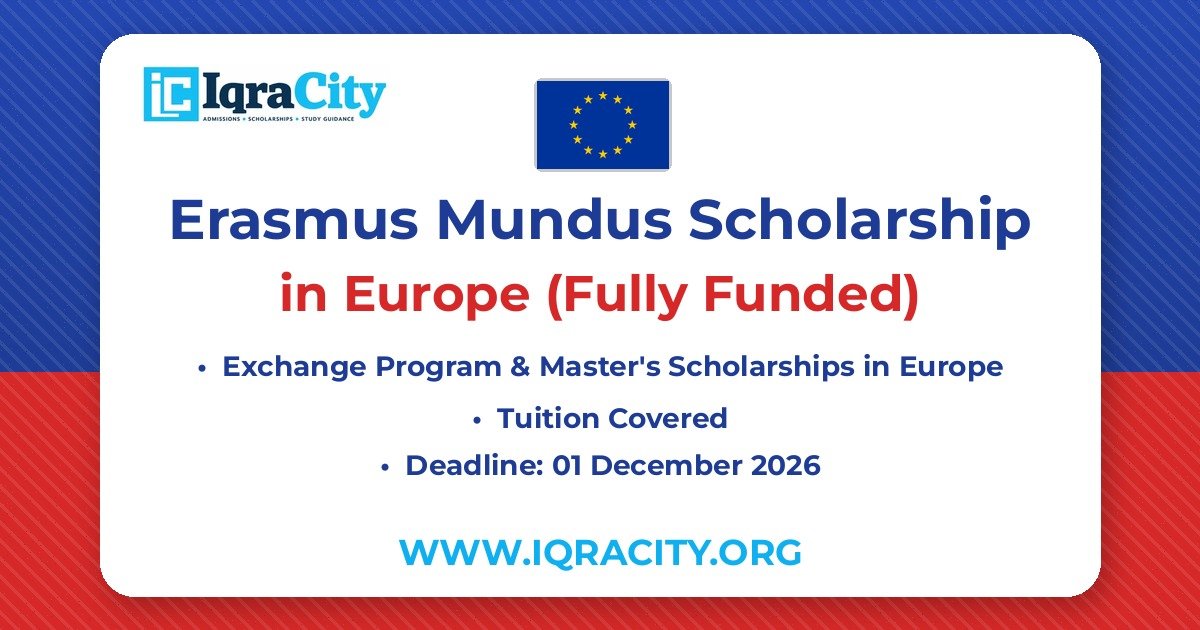
In short: To apply for Erasmus Mundus 2027, search the official EMJM catalogue, pick up to three programmes matching your background, and apply directly to each consortium — usually between October 2026 and January 2027. (Erasmus Mundus application guide) The scholarship pays €1,400 per month plus all tuition and participation costs, open to all nationalities with a bachelor's degree (or one nearly finished).
Check Official Website
Quick Overview
- Host Country: Multiple European countries (study route depends on the programme)
- Host Institution: Consortia of at least 3 institutions from at least 3 countries
- Degree Level: Master's (60, 90, or 120 ECTS)
- Program Duration: 12–24 months
- Funding Type: Fully Funded — €1,400/month + participation costs, travel, visa and installation covered
- Deadline: No single deadline — most programmes accept applications between October and January for courses starting the following academic year
How the Scholarship Actually Works
Erasmus Mundus Joint Masters are international master's degrees jointly designed and delivered by a consortium of universities, plus associated partners from industry and academia. You study and research across several countries, graduating with either a joint degree or multiple degrees, depending on the consortium.
The funding is straightforward once you strip away the jargon. The EU scholarship is calculated at €1,400 per month for the full duration of your programme — 12, 18, or 24 months — an amount the Commission defines as covering travel, visa, installation, and living costs. Scholarship holders are not charged tuition fees or other mandatory participation costs. So a two-year programme means roughly €33,600 in living support plus zero tuition. Keep one number in your head: €1,400.
Three rules that surprise first-time applicants:
- You apply to the programme, not to "Erasmus Mundus." There is no central EU portal — every application goes directly to the consortium running your chosen master's.
- You can apply to a maximum of three different EMJM programmes per intake — so choose well.
- Each programme sets its own deadline, requirements, and document list. Most windows fall between October and January, but the catalogue entry for each programme is your only source of truth.
Step 1: Find the Right Programmes in the Official Catalogue
This is where most successful applications begin. Start at the official Erasmus Mundus course catalogue (linked from the Erasmus+ EMJM page) — the Commission lists well over 200 programmes there, with a fresh batch added each year. Filter with intent:
1. Match your bachelor's field first. Almost every programme has hard academic prerequisites, and eligibility is decided by these rules before anything else. Shortlist only programmes where your degree genuinely fits. 2. Read the mobility route. The catalogue shows which universities you'll attend and in which order. Could you live there for 6–12 months? Your €1,400 stretches very differently in Tartu versus Copenhagen. 3. Confirm scholarships are available for your intake. Some listed programmes' funding periods have ended. If a programme isn't offering scholarships for 2027, move on. 4. Note the deadlines and shortlist three. Write each programme's deadline, documents, and language tests into a simple table — similar requirements let you reuse preparation effort intelligently.
Spend a week on this step. The applicant who understands the curriculum can write a credible motivation letter; the one who applied on vibes cannot.
Step 2: Get Your Documents Ready Before the Portals Open
There is no universal document list, but the standard package looks like this:
- Bachelor's degree certificate and transcript (or proof of expected graduation — you must graduate before the master's starts). Many consortia require certified copies or apostilles, plus English translations.
- Proof of English proficiency — IELTS, TOEFL, Cambridge, or PTE, per the programme's minimums (typically around IELTS 6.5 or TOEFL iBT 90). Book months ahead; results take weeks.
- CV — ideally in Europass format, which many programmes explicitly request.
- Motivation letter — the single most important document in most selections (see Step 3).
- Recommendation letters — usually one or two, from people who have actually supervised your work.
- Passport copy — check the expiry date now.
- Programme-specific extras — portfolios, writing samples, proof of residence. Your programme's page is the final checklist.
Warning: once submitted, many portals do not let you edit your application — submit only when everything is final.
Step 3: Write a Motivation Letter That Isn't Generic
Committees read hundreds of these, and most are interchangeable. A strong letter does three specific things:
1. Proves you understand this specific programme. Name the curriculum, the mobility route, and the partner universities. Explain *why* this route fits your trajectory better than any single-university master's — generic letters are the first thing committees filter out. 2. Connects your past to your future. Pick two or three concrete experiences — a final-year project, an internship, a technique you mastered — and show how they lead into this master's and the work you want to do. 3. Answers the programme's actual questions. Many consortia publish explicit prompts. Answer every one, in the order asked, within the character limit — ignoring them signals you didn't read the instructions.
Two hard rules: write it yourself — plagiarism checks mean disqualification for copied or AI-generated text — and get it reviewed by someone who knows the field, not just someone who knows English.
Step 4: Build a CV and Recommendation Letters That Support You
Lead your CV with education and the academic projects most relevant to the programme, then research, internships, and work experience. For each entry, write one line about what *you* did — "final-year project on HPLC method validation; presented at departmental seminar" beats "completed final-year project." Keep it to two pages and follow the format the programme specifies.
For recommendation letters, choose referees who have directly seen your work — a thesis supervisor, a lab instructor, an internship manager. A detailed letter from an assistant professor who taught you for a year beats a vague paragraph from a famous name. Contact referees at least a month before the deadline, and share your CV plus a draft of your motivation letter.
Step 5: Submit Early, Then Work the Timeline
Application windows for the 2027 intake will largely open in autumn 2026 and close between December 2026 and January 2027 — but your programmes' exact dates are what count:
- Submit at least a week before the deadline. Portals get slow, uploads fail, and referees go quiet.
- Keep a tracker. For each programme: deadline, documents uploaded, referee status, confirmation email.
- Watch your email, including spam — test invitations and missing-document notices often come with short response windows, and a test link sitting in spam for a week can end your candidacy.
- Prepare for selection tests. Several programmes run online tests a few weeks after the deadline — ask alumni or check programme forums for what to expect, and revise the fundamentals.
Working backwards from a typical early-January deadline: shortlist and book your English test in Sep–Oct 2026; draft letters and certify documents in Oct–Nov; submit as portals open in Nov–Dec; sit tests in Jan–Feb 2027; expect decisions Feb–Apr; arrange visas over the summer for an Aug–Sep 2027 start.
Common Mistakes That Sink Applications
Avoid these and you're already ahead of most of the applicant pool:
- Programmes that don't match your degree. Credit requirements are hard filters — no motivation letter overrides them.
- One generic motivation letter for three programmes. Committees can tell instantly. Each letter must reference the specific curriculum, universities, and mobility route.
- Missing the English test deadline — the certificate must usually be in hand by the application deadline, so book early.
- Weak or late referees. A two-sentence letter — or none at all — quietly damages an otherwise strong file. Choose people who will actually write, and give them time.
- Ignoring the three-programme rule. More than three EMJM applications per intake can disqualify you.
- Assuming the scholarship is automatic. It goes to the best-ranked applicants in each selection. You're competing for admission *and* funding — treat both as competitive. And submit early: portals crash and uploads fail on deadline day, every year.
Frequently Asked Questions
Is the Erasmus Mundus scholarship really fully funded?
Yes. Scholarship holders pay no tuition or mandatory participation costs and receive €1,400 per month — defined by the Commission as covering travel, visa, installation, and living costs. That's roughly €33,600 plus zero tuition over two years. Miss the scholarship and many consortia still admit self-funded or tuition-waiver students.
Do I need IELTS to apply?
Not necessarily a specific test — but almost every programme requires documented English proficiency, each with its own accepted tests and minimums (commonly around IELTS 6.5 or TOEFL iBT 90).
Can I apply in my final year of bachelor's?
Yes, as long as you graduate before the master's starts — you'll typically get a conditional offer, with the final certificate due by the consortium's deadline. There is no age limit.
Can I apply if my grades are average, or without work experience?
Possibly — there is no single CGPA requirement, and selection weighs motivation, experience, and tests alongside grades. Work experience and publications are not common requirements at master's level.
Where can I get help from people who've done this?
The Erasmus Mundus Association (the official alumni network) runs applicant resources and events with volunteer representatives — the Erasmus+ page links to it directly. Talking to alumni of your target programme is the best way to learn what a consortium values.
Final Words
Erasmus Mundus rewards the prepared. The winners are usually the ones who started in September, read the programme pages properly, wrote three genuinely tailored letters, and submitted with a week to spare. Pick your three programmes this week and start writing — the €1,400 a month and the multi-country degree are real, and they're going to someone.
Related Scholarships
More opportunities you may also qualify for:
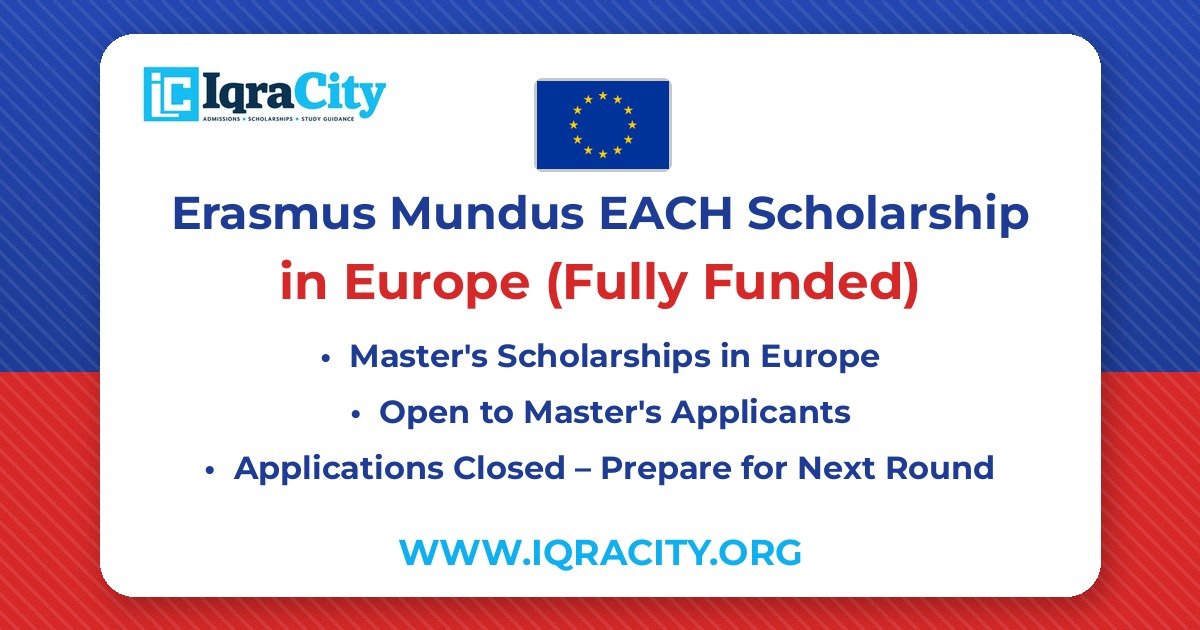
- Erasmus Mundus EACH Scholarship 2027 | Analytical Chemistry Master's in Europe · Europe • Fully Funded
- Erasmus Mundus Scholarship 2027 | Fully Funded Joint Masters in Europe · Europe • Fully Funded
- EU Blue Book Traineeship 2027 in Europe (Paid Internship) · Europe • Scholarship
- Google Gemini Student Plan 2026 | Google AI Plus Free for 1 Year · Multiple Countries • Scholarship