Imagine spending a full year in London working with some of the rarest Coptic manuscripts on the planet — papyrus and parchment fragments that document more than 1,500 years of history, theology and literature. That is exactly what the Chevening British Library Coptic Collections Fellowship offers. Co-funded by the British Library and the UK Foreign, Commonwealth and Development Office (FCDO), this fully funded fellowship places mid-career professionals from Egypt, Sudan and Palestine at the heart of one of the world's most significant Coptic manuscript collections. If your work lives at the intersection of manuscripts, heritage and research, read on — the deadline is 27 October 2026.
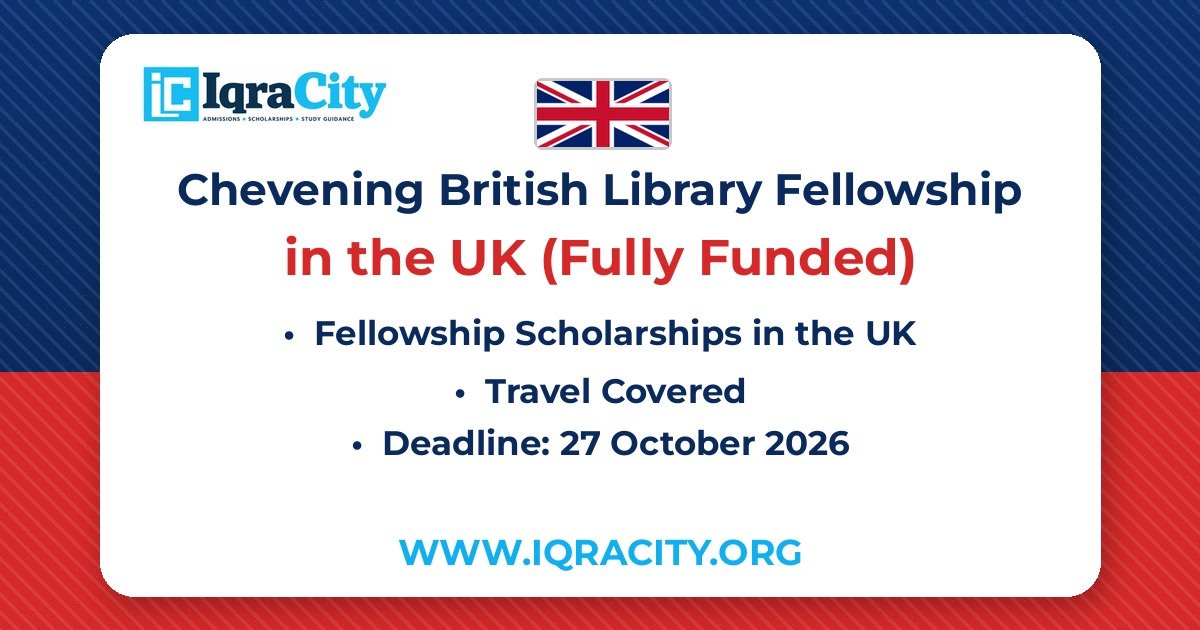
In short: The Chevening British Library Fellowship 2027 is a fully funded, 12-month research fellowship at the British Library in London (September 2027 to September 2028) for mid-career professionals from Egypt, Sudan and Palestine with strong Coptic language skills. It covers living expenses, return airfare and project costs. Applications close 27 October 2026 at 12:00 UTC.
Quick Overview
- Host Country: United Kingdom
- Host Institution: The British Library, London
- Degree Level: Fellowship (mid-career professionals; no degree programme)
- Program Duration: 12 months (September 2027 – September 2028)
- Funding Type: Fully Funded
- Deadline: 27 October 2026, 12:00 UTC
Benefits of the Chevening British Library Fellowship
This is not a symbolic award. The fellowship covers the real costs of a year in London so you can focus entirely on the research.
- Living expenses — your accommodation and day-to-day costs in London are covered for the full 12 months.
- Return economy airfare — flights to and from the UK are included. Do note the FCDO does not arrange travel itself; successful fellows arrange their own journey, potentially via third countries, so plan early.
- Activity allowance package — a dedicated allowance for fellowship-related activities such as conferences, research visits and professional development.
- Project expenses — up to £1,000 for approved project-related costs like digitisation support, research materials or event costs.
- World-class supervision — you will work closely with Dr. Michael Erdman (Head of Asian and African Studies, interim) and the British Library's curatorial teams, building skills in manuscript cataloguing, provenance research and collections documentation.
- Professional visibility — your outputs (catalogue records, blogs, reports, events) become part of the public record at a major research institution.
Eligibility Criteria for the Chevening British Library Fellowship
The bar is specific because the work is specialist. Alongside Chevening's standard fellowship eligibility rules, you must meet all of the following:
- Nationality and residence — be a citizen of Egypt, Sudan or Palestine. Citizens of these countries living elsewhere in Chevening-eligible, ODA-eligible MENA countries (Iran, Iraq, Jordan, Lebanon, Libya, Morocco, Syria, Tunisia and Yemen) may also be considered — check the official page for the exact residency options.
- Return commitment — have a clear intention to return to and contribute to your country of citizenship for at least one year after the fellowship ends.
- Qualifications — hold a postgraduate-level qualification, or equivalent professional training or experience in a relevant area, at the time of application.
- Experience — have at least five years of significant professional and/or academic research experience.
- Current status — be currently employed, or enrolled as a PhD candidate (the PhD must not be with a UK/EU or USA university).
- Coptic language skills — excellent knowledge of Coptic (Sahidic or Bohairic) is essential; Arabic and/or Greek are desirable.
- Manuscript expertise — experience cataloguing and handling manuscripts, with knowledge of description standards.
- Provenance and community work — provenance research experience or a demonstrable interest in it, plus experience engaging heritage communities or cultural-heritage audiences.
- English — good written and spoken English.
How to Apply for the Chevening British Library Fellowship
Applications are submitted online through Chevening's application portal. Here is the process step by step:
1. Read the official fellowship page on chevening.org and confirm you meet every eligibility point, especially the nationality, language and experience requirements. 2. Start your application in the Chevening online application system. Select your country/territory and choose the British Library Coptic Collections Fellowship from the list of available awards. 3. Prepare your research project outline — this fellowship is project-based, so a clear, well-thought-out proposal for your year at the British Library is central to your application. 4. Gather your documents (see checklist below) and upload everything the portal requests. 5. Submit before the deadline — 27 October 2026 at 12:00 UTC. Late applications are not accepted under any circumstances. 6. After submission — shortlisted candidates are typically invited for an interview process before final selection.
Required Documents
The official call asks for standard Chevening fellowship documentation. Prepare:
- Completed online application form with your project proposal
- CV or resume detailing your professional and research experience
- Valid passport or national ID
- Academic certificates and transcripts for your postgraduate qualification
- Evidence of English language ability
- Any supporting documents the portal requests (references may be required at later stages)
Chevening British Library Fellowship Deadline
Applications for the 2027–2028 fellowship close on 27 October 2026 at 12:00 UTC. This deadline is firm — the Chevening portal locks and late submissions cannot be considered. Because this is a specialist fellowship with a small cohort, shortlisting can be highly competitive, so do not leave your application to the final days. Submit early to avoid technical problems.
Frequently Asked Questions
Is the Chevening British Library Fellowship really fully funded?
Yes. The fellowship covers living expenses for the full 12 months, return economy airfare to the UK, an allowance for fellowship-related activities, and up to £1,000 for approved project-related expenses. It is co-funded by the British Library and the FCDO.
Who exactly is this fellowship for?
Mid-career professionals — researchers, curators, archivists, librarians and heritage specialists — from Egypt, Sudan or Palestine, with at least five years of experience, strong Coptic language skills (Sahidic or Bohairic) and manuscript cataloguing expertise. It is not a student scholarship.
How long does the fellowship last, and when does it start?
Twelve months, running from September 2027 to September 2028, based at the British Library in London.
What will I actually do during the fellowship?
You will lead a research project: surveying the British Library's Coptic holdings, creating and improving catalogue records, researching manuscript provenance, analysing the history and acquisition of the collections, and developing public and community engagement — including blogs, reports, events and research outputs with Coptic community members and researchers.
Can I apply if I live outside Egypt, Sudan or Palestine?
Citizens of these three countries who are resident elsewhere in Chevening-eligible, ODA-eligible MENA countries (such as Iran, Iraq, Jordan, Lebanon, Libya, Morocco, Syria, Tunisia and Yemen) may also be eligible. Confirm your situation against the official page before applying.
Do I need a PhD to apply?
No. A postgraduate qualification or equivalent professional training and experience is required, plus five years of significant professional or academic research experience. You may also apply as a currently enrolled PhD candidate, as long as your PhD is not at a UK/EU or USA university.
How good does my Coptic need to be?
Excellent — the fellowship specifically requires excellent knowledge of Coptic (Sahidic or Bohairic). Arabic and/or Greek are desirable extras, and good written and spoken English is required.
Does the FCDO arrange my travel to the UK?
No. The fellowship includes return economy airfare funding, but the FCDO does not arrange or facilitate travel to the UK. Fellows are responsible for arranging their own journey, potentially through third countries, so start planning well in advance.
Can I reapply if I was unsuccessful before?
Chevening generally allows reapplications in subsequent cycles if you still meet the eligibility criteria. Check the current application guidance on the official site for any cycle-specific rules.
Final Words
Fellowships this specialised do not come around often. If you have spent years with Coptic manuscripts and want to spend a funded year advancing the world's knowledge of them — while building an international professional network — this is genuinely one of the best opportunities in the field. Get your proposal polished and your documents ready well before 27 October 2026.
Related Scholarships
More opportunities you may also qualify for:
- Chevening OCIS Fellowship 2027 in the UK | Fully Funded to Oxford · UK • Fully Funded
- Cambridge ERA AI Fellowship 2027 in UK | Fully Funded · UK • Fully Funded
- Commonwealth Fellowships 2027 in the UK | Fully Funded · UK • Fully Funded
- Chevening LSE Fellowship 2027 in the UK | Fully Funded · UK • Fully Funded