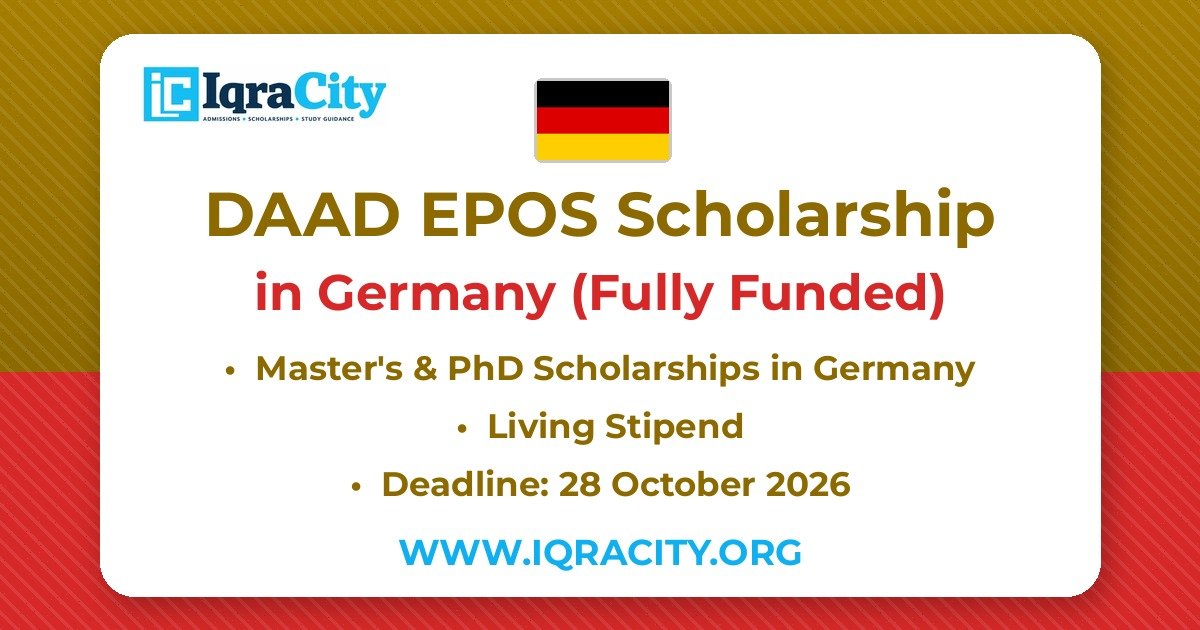
If you've been working in your home country for a few years and keep thinking a world-class Master's degree could change the trajectory of your career, the DAAD EPOS Scholarship 2027-28 might be exactly what you're waiting for. Run by the German Academic Exchange Service (DAAD) and funded by the German government, this is one of the most generous fully funded scholarships in Europe — it covers living costs, insurance, and travel while you earn a postgraduate degree at a German university. The catch? It's built for professionals, not fresh graduates, and the deadlines arrive sooner than most people expect.
In short: The DAAD EPOS (Development-Related Postgraduate Courses) Scholarship 2027-28 funds professionals from developing and newly industrialized countries to complete a Master's — and in exceptional cases a PhD — in Germany. (DAAD EPOS Scholarship) It pays a monthly stipend of €992 for graduates and €1,300 for doctoral candidates, plus insurance and travel. Deadlines vary by course, with most 2027/28 intake deadlines falling between August and October 2026.
Quick Overview
- Host Country: Germany
- Host Institution: State-recognized German universities offering DAAD-listed postgraduate courses
- Degree Level: Master's/Postgraduate (PhD in exceptional cases)
- Program Duration: 12 to 42 months (depending on the course)
- Funding Type: Fully Funded (DAAD scholarship)
- Deadline: Varies by course — most 2027/28 deadlines fall between August and October 2026 (CET/CEST)
Benefits of the DAAD EPOS Scholarship 2027-28
The honest reason this scholarship is so competitive: it removes money from the equation almost entirely. Public German universities generally don't charge tuition, so the funding goes where you actually need it — living costs.
- Monthly stipend of €992 — paid to Master's-level scholarship holders to cover rent, food, and daily expenses in Germany.
- €1,300 per month for doctoral candidates — rising to €1,400 per month from February 2026, per DAAD's official programme terms.
- Insurance covered — DAAD pays towards health, accident, and personal liability insurance, so you're not navigating the German health system out of pocket.
- Travel allowance — funding for your flights between your home country and Germany, unless your home country or another sponsor already covers it.
- Rent and family support — under certain circumstances, scholars can receive a monthly rent subsidy and an allowance for accompanying family members.
- German language preparation — courses taught in German include a preparatory 6-month German language course in Germany before your studies begin.
Eligibility Criteria for the DAAD EPOS Scholarship 2027-28
EPOS is aimed squarely at working professionals from the developing world — academics generally don't count, and neither do people just out of university. Here's the official checklist:
- Nationality — you must be a graduate from a developing or newly industrialized country on the OECD DAC list (this covers most of Africa, Asia, Latin America, and parts of Eastern Europe).
- Professional experience — at least two years of relevant professional experience after your first degree, gained by the time you apply. You should work for a public authority or a state or private company in a developing country, in a role connected to development policy or practice.
- Degree — a Bachelor's degree (normally a four-year course) in a subject related to the course you're applying for.
- Academic results — completed with far above average results, i.e., in the upper third of your class.
- Degree age — your academic degrees should normally be no more than six years old.
- Residency rule — applicants who have lived in Germany for longer than 15 months by the application deadline cannot be considered.
- Development motivation — you must be able to show your motivation is development-related: DAAD expects you to take on social responsibility and support change back home after your training.
- Language — for English-taught courses, proof of adequate English skills per the course's rules; for German-taught courses, at least B1 German at the time of application.
One more practical note: you can apply for up to three courses, ranked in priority order. That's it — no more than three, and your motivation letter needs to explain your choices and ranking clearly.
How to Apply for the DAAD EPOS Scholarship 2027-28
This is the step where most applications die quietly: you do NOT apply to DAAD. Everything goes to the course itself. Follow this order:
1. Choose your courses. Download DAAD's official "List of all Postgraduate courses with application deadlines 2027/2028" from the EPOS programme page and pick up to three programmes that match your degree and work experience. 2. Check each course's page. Every programme publishes its own deadline, language requirements, and document list on its university website. Read these carefully — they override anything general. 3. Prepare your documents. Assemble the full package in the exact order the official checklist requires (see below). Complete applications are accepted only in English or German. 4. Send your application directly to the course. Submit before that course's deadline. Applications sent to DAAD itself will not be forwarded to the course. 5. Course-level selection. A selection committee at the course/university reviews applications and nominates potential DAAD scholarship candidates. 6. Upload to the DAAD portal. If nominated, DAAD contacts you to upload your complete application documents to the DAAD portal. 7. Final decision. DAAD finalizes the selection and informs the suggested candidates. Successful scholars typically begin their studies in autumn 2027.
Required Documents
These are the official EPOS requirements. Some courses ask for extras, so always cross-check the programme page:
- Completed and signed DAAD EPOS checklist
- EPOS application form (typed, or handwritten very clearly)
- Curriculum vitae in reverse chronological order with no unexplained gaps — use the Europass template, with exact details of your studies and practical experience
- Letter of motivation with detailed academic, professional, and personal reasons for applying (one uniform letter explaining your course choices and priority ranking if you apply to more than one course)
- Letter of recommendation from your current employer, on official letterhead with signature and official stamp, currently dated
- Certificate(s) of employment showing at least two years of relevant work experience after your Bachelor's degree, plus — if possible — a guarantee of re-employment from your current employer when you return home
- Recent proof of language skills: English — IELTS or TOEFL (note: the institutional TOEFL is not accepted); German — required for courses taught in German
- Copies of higher education degree certificates (with certified translation if the original isn't in German or English)
- Copy of your full transcript of records, with an explanation of the grading system if it isn't part of the transcript
- APS certificate — required for applicants from China (some courses also require it for other countries, so check)
Incomplete applications are not considered. And double-check every stamp and signature — missing ones are a formal rejection.
DAAD EPOS Scholarship 2027-28 Deadline
There is no single DAAD EPOS deadline, and that's the most important thing to understand. Each postgraduate course sets its own application deadline, and DAAD publishes them all in the official "List of all Postgraduate courses with application deadlines 2027/2028" on the EPOS programme page. For the 2027/28 intake, the pattern is consistent: most deadlines land between August and October 2026 — many on 15 October or 31 October 2026, some as early as 31 August 2026. A few programmes close even earlier. Since you apply a full year before your studies start, treat autumn 2026 as your hard window. Miss your chosen course's date and the application simply isn't considered — there's no late round.
Frequently Asked Questions
Is the DAAD EPOS Scholarship really fully funded?
Yes, in the sense that matters. German public universities don't charge tuition, and DAAD covers your living costs with a €992 monthly stipend (€1,300 for PhD candidates, €1,400 from February 2026), plus insurance contributions, a travel allowance, and in some cases rent and family subsidies. You're not paying to be there.
Can fresh graduates apply for the DAAD EPOS Scholarship?
No. You need at least two years of relevant professional experience gained after your first degree, at the time of application. Work in academia generally doesn't count — the programme wants people in development-relevant professional roles.
What are the application deadlines for the DAAD EPOS 2027-28 intake?
They vary by course. DAAD publishes a single official deadline list for all EPOS postgraduate courses for 2027/28. Most deadlines fall between August and October 2026 (15 October and 31 October 2026 are common), with a few closing in August 2026 or earlier. Check your chosen course's exact date on the official list.
Do I apply to DAAD or to the university?
To the university course — directly. You send your complete application to the postgraduate course you've chosen. Applications sent to DAAD will not be forwarded. Only candidates the course nominates later upload their documents to the DAAD portal.
How many courses can I apply to?
A maximum of three. If you apply to more than one, list them in priority order on the DAAD application form and don't change the priorities between forms. You must also submit one uniform motivation letter explaining your course choices and ranking.
Can I apply for a PhD through EPOS?
Only in exceptional cases. EPOS is fundamentally a postgraduate/Master's programme. Doctoral funding exists but is rare — your PhD project needs to fit the development-oriented scope of the programme closely.
Do I need IELTS or German language skills?
For English-taught courses, you need proof of adequate English (IELTS or TOEFL — the institutional TOEFL isn't accepted). For German-taught courses, you need at least B1 German at application time, and the scholarship includes a 6-month German language course in Germany before your programme starts.
My degree is more than six years old. Can I still apply?
The rule says degrees should "normally" not be more than six years old. That "normally" leaves a little room, but older degrees are a real disadvantage — check with the specific course before investing weeks in an application.
I'm already in Germany. Can I apply?
Only if you haven't been resident in Germany for longer than 15 months at the application deadline. Longer than that, and you can't be considered.
Final Words
The DAAD EPOS Scholarship is one of the few awards in the world designed for people already doing the work — not students planning their first job. If you have the degree, the experience, and a genuine development purpose for your studies, it's worth the effort of a serious application. Just respect the process: read your chosen course's page line by line, get your employer documents stamped and dated properly, and send everything directly to the course well before autumn 2026 runs out.
Related Scholarships
More opportunities you may also qualify for:
- FRIAS Fellowship 2027/28 in Germany (Fully Funded) · Germany • Fully Funded
- DAAD Re-Invitation Programme 2027 in Germany (Fully Funded) · Germany • Fully Funded
- UN Youth Townhall 2026 in Heidelberg, Germany (Fully Funded) · Germany • Fully Funded
- Max Planck MTL Internship 2027 in Germany (Fully Funded) · Germany • Fully Funded