If you have been thinking about a fully funded master's in the UK, Chevening is probably the biggest name on your list — and the application is unlike a typical university application. There is no transcript-upload frenzy on day one, no English test requirement from Chevening itself, and no need to hold a university offer when you apply. What Chevening does ask for is much harder to fake: a clear story of your leadership, your network, your career plan, and why studying in the UK fits into it — all written by you, all in English, and all inside one online form.
The good news is that the process itself is straightforward once you know the steps. The tricky part is the discipline: every section of the form matters, the portal logs you out after fifteen minutes of inactivity, and the deadline is enforced to the minute. This guide walks you through the entire application exactly as the official Chevening process works for the 2027 cycle — applications open 4 August 2026 and close 6 October 2026 at 11:00 UTC — so you can plan your weeks instead of panicking through them.
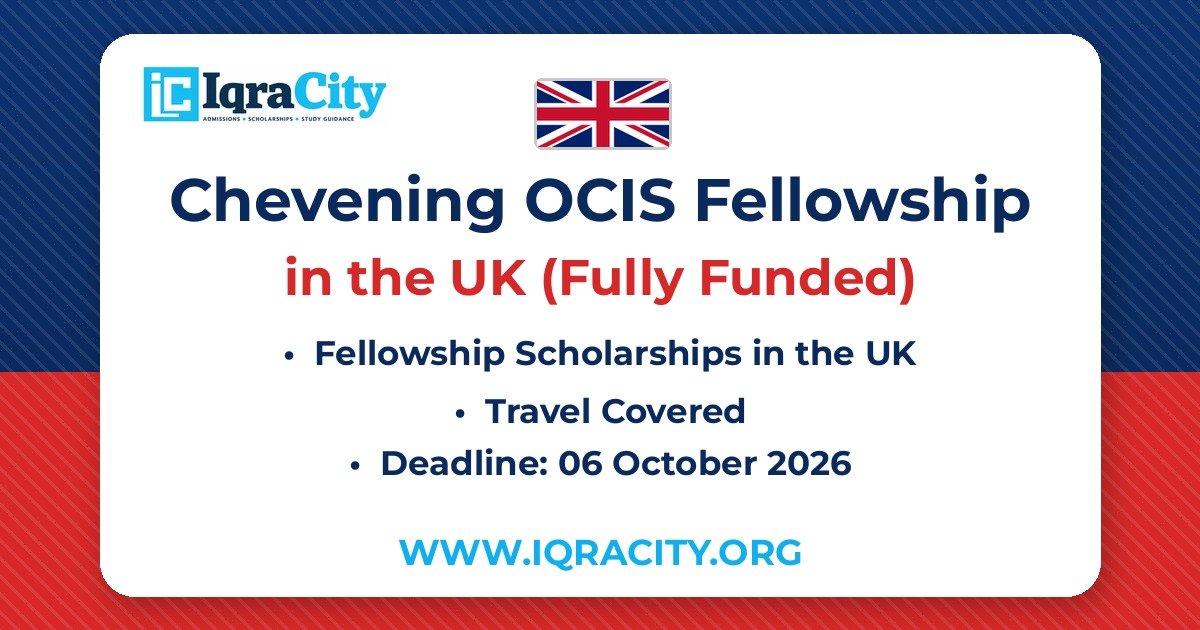
In short: Chevening Scholarship 2027 is the UK government's fully funded one-year master's scholarship for professionals from 160+ countries, and you apply through the Chevening online application system on chevening.org. You complete an eligibility checker, fill in personal, education, and work history sections, choose three UK master's courses, name two referees, and write four 500-word essays. The application deadline is 6 October 2026 at 11:00 UTC — late applications are never accepted.
Quick Overview
- Host Country: United Kingdom
- Host Institution: Any eligible UK university (your choice)
- Degree Level: One-year taught Master's (not MPhil, PhD, or distance/part-time programmes)
- Program Duration: 12 months of study, starting September/October 2027
- Funding Type: Fully funded — tuition fees, monthly living stipend (~£1,347), return economy airfare, one visa application, arrival and homeward departure allowances, and a travel grant for Chevening events
- Deadline: 6 October 2026, 11:00 UTC (4:00 PM Pakistan time / 4:30 PM India time — no extensions, no exceptions)
What Chevening Is Looking For (Before You Touch the Form)
Before you write a single word, understand what the readers are scoring. Chevening weighs leadership potential and post-study impact as heavily as grades — there is no fixed minimum GPA, and Chevening itself does not ask for an English test score. The application is judged against four criteria, and the four essays map to them directly:
- Leadership and influence — not a job title. A specific moment where your action changed outcomes for others, with the problem, what you did, and the result.
- Networking — how you build and use professional relationships, and how you would use the Chevening alumni network specifically.
- Studying in the UK — a research-based reason why these particular UK courses serve your goals, not generic praise for British education.
- Career plan — a concrete, ambitious but believable ten-year trajectory where the UK master's is the missing link.
If you cannot yet answer "what changes when I come home?" in two sentences, spend your prep time there. Everything else in this guide is mechanics.
Eligibility at a Glance (Check This First)
You must meet every one of these, or the system rejects you before a human reads anything:
- Citizenship — citizen of a Chevening-eligible country or territory (160+ countries; check your country's page on chevening.org for slight local variations).
- Undergraduate degree — completed, at a level that gets you into a UK postgraduate course — broadly, the equivalent of a UK upper-second-class (2:1) honours degree.
- Work experience — at least 2,800 hours after your undergraduate degree, roughly two years of full-time work. Paid, voluntary, part-time, and internships all count; the system auto-calculates your hours.
- Three UK master's courses — you must apply to three eligible one-year taught master's courses and hold an unconditional offer from at least one by 8 July 2027.
- Return commitment — you commit to returning to your home country for at least two years after the award. This is a contractual condition, not a suggestion.
- Not eligible — British or dual British citizens (with specified exceptions), people resident in the UK at the time of application, and employees or close relatives of employees of the FCDO, British Council, partner universities and related bodies.
Already having a master's degree does not disqualify you — you can apply for a second one.
How to Apply for Chevening Scholarship 2027 — Step by Step
Step 1: Go to chevening.org/apply and pick your country
During the application window, open the official Chevening website and click through to the Apply page. Select your country or territory of citizenship. Chevening runs country-specific pages with local guidance and interview arrangements, so make sure you are applying through your own country's route — this matters for the interview location later.
Step 2: Create your account on the online application system
Register with a valid email address you will keep active for the whole cycle — roughly a full year. Chevening sends account confirmation, shortlisting news, interview invitations, and results to this address. After registering, you will get a confirmation email; click the link inside to verify the account. If it doesn't arrive, check spam and double-check you typed the address correctly before re-registering.
Step 3: Log in and pass the eligibility checker
Sign in with your registered email and password, then complete the eligibility checker first. This is a series of yes/no and factual questions confirming you meet the basic requirements. If you pass, the system generates a unique access code — save it somewhere safe, because you'll need it if you lose access to your application. If you fail the checker, you cannot proceed, which is why Step 1's country selection and the eligibility list above matter.
Step 4: Work through each section of the form
Read the instructions at the top of the application before typing anything. The system logs you out after 15 minutes of inactivity, so save your progress constantly — treat every completed section as a small victory and hit save.
- Personal details — your full name, pronouns, date of birth, address, and preferred interview location. Use the name exactly as it appears on your passport.
- Immigration details — country of citizenship, passport number if you have one, and other required immigration information.
- Education history — every institution you attended, courses completed, and results. You can add up to 15 education records, so don't panic about running out of space — but keep each entry accurate.
- Work history — every job you have held after your undergraduate degree, up to 15 entries. Enter the number of weeks and hours per week; the system multiplies them to check you against the 2,800-hour minimum. Be honest — inflated hours are easy to spot at interview.
- Programmes of study — your three chosen UK master's courses, in order of preference. You do not need university offers at this stage, and you do not even need to have applied to the universities yet — but research the courses properly, because the "Studying in the UK" essay will expose a careless choice.
- Referees — names, job titles, and contact details of two referees who know you professionally or academically. They cannot be relatives or close friends. They don't submit letters at this stage — they only need to be ready, because if you are shortlisted in February, Chevening contacts them and the letters must reach the system by the end of the interview period.
Step 5: Apply to your three UK universities separately
This is the part most applicants underestimate. Your Chevening application and your university applications are two completely separate processes. Apply directly through each university's website, watch each university's own deadlines (many close well before July), and work toward securing at least one unconditional offer by 8 July 2027. Use Chevening's Course Finder to shortlist programmes, then compare course content, entry requirements, fees, and application deadlines on the universities' own pages.
Step 6: Write the four essays (500 words each)
The essays are the heart of your application and the place where most candidates are made or broken. Four questions, 500 words maximum each, in English. Draft them in a separate document first — never write them directly in the portal — and use the STAR structure (Situation, Task, Action, Result) to keep every essay anchored in real examples:
- Leadership and influence — describe a situation where you had a positive influence on others: what you did and what the impact was. Show the challenge you faced and how you overcame it.
- Networking — how you have built and maintained professional relationships in the past, with concrete impact, and how you plan to use the Chevening network in the future.
- Studying in the UK — why these three specific courses and universities, and why studying in the UK specifically matters for your development. Name real modules, faculty, or resources.
- Career plan — where you want to be in ten years and exactly how the master's and the Chevening experience bridge the gap.
Then complete the equal-opportunities section, which asks about your background for diversity monitoring. It does not affect your outcome — answer it honestly and move on.
Step 7: Review everything, then submit
Read the whole application end to end. Check names against your passport, hours against reality, course titles against the universities' websites, and every essay against its word limit. Submit at least 48 hours before the deadline — the portal locks at exactly 11:00 UTC on 6 October 2026, and last-minute technical problems have ended real applications.
Step 8: After submission — the timeline
- From October 2026 — applications are checked against the eligibility criteria; ineligible ones are removed.
- Mid-October 2026 to January 2027 — independent reading committees assess and score every eligible application.
- Mid-February 2027 — shortlisted candidates are notified and invited to interview; referees are contacted for their letters.
- March–April 2027 — interviews at British embassies and high commissions worldwide.
- From mid-June 2027 — results announced; successful candidates receive conditional offers.
- By 8 July 2027, 17:00 BST — conditionally selected scholars must submit at least one unconditional UK university offer.
- September/October 2027 — studies begin in the UK.
Required Documents
Chevening is deliberately light on documents at the application stage — it is testing you, not your paperwork:
- Completed online application — the form itself, with all sections saved and submitted.
- Valid passport — or national ID for the application; a passport becomes essential later.
- Undergraduate degree certificate and transcripts — for the education history section and later for university offers.
- Work history records — dates, roles, and hours for each position.
- Two referees' details — names, job titles, contact information; reference letters are only uploaded later if you are invited to interview.
- Three chosen UK master's courses — with research behind each choice; separate university applications submitted directly to the institutions.
No CV, no English test certificate, and no application fee — Chevening does not charge to apply. If anyone asks you for money to apply for Chevening, it is a scam.
Chevening Scholarship 2027 Deadline
Applications for the 2027 cycle open 4 August 2026 and close 6 October 2026 at 11:00 UTC — that is 4:00 PM Pakistan time or 4:30 PM India time on the same day. There are no extensions and no exceptions; the online system simply becomes inaccessible after the cut-off.
If you miss it, this cycle is over for you — there is no late lane. Your honest options are to prepare for the next cycle (applications reopen the following August) or, if you are shortlisted, remember that the unconditional university offer has its own hard deadline of 8 July 2027, 17:00 BST. Confirm the exact times on chevening.org/apply for your country before you finalize your plan.
Frequently Asked Questions
Do I need a university offer before applying for Chevening?
No. You only need to name three eligible UK master's courses in your application. You apply to universities separately and only need one unconditional offer by 8 July 2027. Start university applications early anyway — their deadlines are independent of Chevening's.
Is the Chevening Scholarship really fully funded?
Yes. It covers your full university tuition fees, a monthly living stipend of about £1,347 (adjusted for London versus other cities), return economy airfare to the UK, the cost of one UK visa application, an arrival allowance and a homeward departure allowance, plus a travel grant for attending Chevening events in the UK.
How strict is the 2,800-hour work experience rule?
Very. It is a hard eligibility floor, not a guideline — the application system calculates your hours from the weeks and hours you enter and rejects you if you fall short. Paid work, volunteering, part-time jobs, and internships all count, but only experience after your undergraduate degree.
Does Chevening require IELTS or another English test?
Chevening itself does not require an English language test. However, the UK universities you apply to set their own entry requirements, and many do require IELTS or an equivalent — so check each university's requirements when you shortlist courses.
How important are the essays, really?
They are the single most important part of your application. Grades and work history get you through the eligibility check, but the four 500-word essays — on leadership, networking, studying in the UK, and your career plan — are what the independent reading committee scores. Prepare them with the same seriousness you would give a job interview.
Can I change my three course choices after submitting?
The brief's honest answer: minor corrections are sometimes accommodated, but you should treat your submitted choices as final. Choose carefully before you submit — your "Studying in the UK" essay is judged against these exact courses.
What happens if my referees don't submit their letters on time?
If you are shortlisted, Chevening contacts your referees directly and the letters must arrive by the end of the interview period. Brief your referees early, share your career story with them, and keep a backup referee in mind. This is not a step to leave until February.
Can I apply for Chevening if I already have a master's degree?
Yes. Holding a master's does not make you ineligible; you can apply for a second master's through Chevening. PhDs, MPhils, and part-time or distance-learning programmes are not eligible — only full-time taught master's degrees.
Does Chevening charge an application fee?
No. Applying to Chevening is completely free. Any website or person asking for payment in exchange for a Chevening application or a guaranteed place is running a scam — report it and walk away.
Can I reapply if I am rejected?
Yes, and many current scholars succeeded on their second or third attempt. Chevening allows reapplication every year. If you were rejected after interview, ask your local British embassy team or alumni network for feedback, strengthen your weakest essay, gain more leadership evidence, and come back stronger.
Final Words
The Chevening application rewards one thing above all: clarity about who you are and where you are going. The portal mechanics take an afternoon to learn; the thinking behind your four essays takes weeks. Give them that time. Research your three courses like a scholar, write your essays like a leader, and treat the 6 October deadline with the respect it deserves.
Related Scholarships
More opportunities you may also qualify for:
- Marshall Scholarship 2027 in UK | Fully Funded Study for Americans · UK • Fully Funded
- How to Prepare Your Chevening Scholarship Application 2027 (Step-by-Step Guide) · UK • Fully Funded
- Scotland Pakistan Scholarships 2026 for Young Women and Girls | Fully Funded · UK • Fully Funded
- How to Prepare Your Chevening Scholarship Application 2027 (Step-by-Step Guide) · UK • Fully Funded