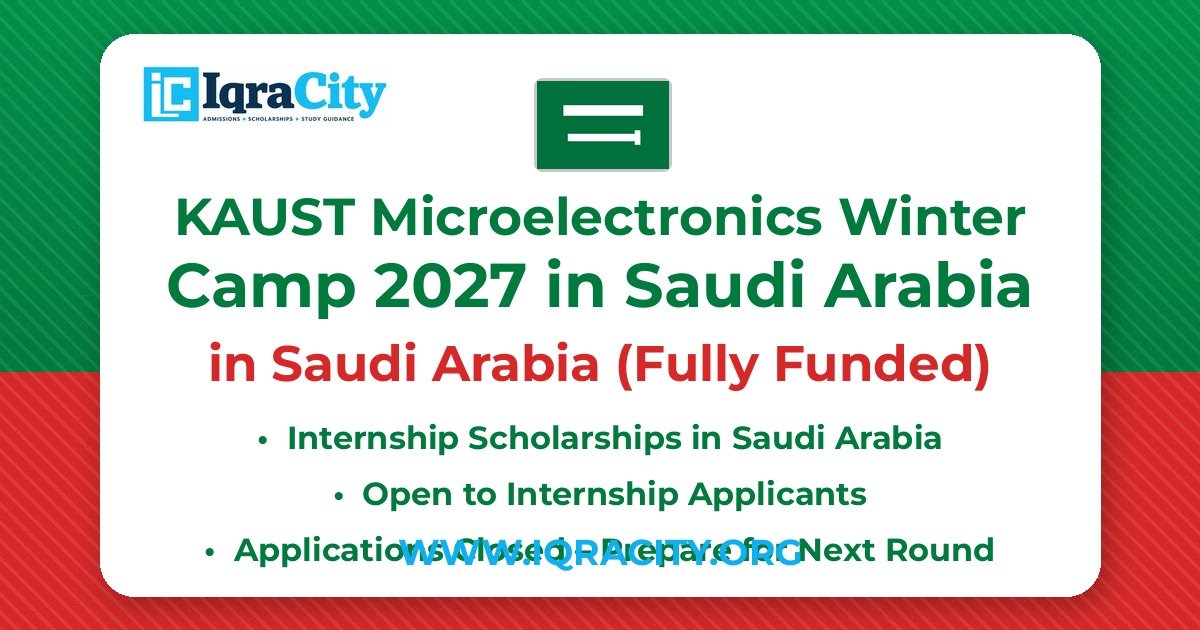
Six weeks inside one of the world's most advanced research universities — working on real microelectronics projects, building a gadget prototype with your own hands, and presenting your work to faculty who build the future for a living. That is what the KAUST Microelectronics Winter Camp (MEWC) 2027 offered: a fully sponsored, six-week research internship at King Abdullah University of Science and Technology in Saudi Arabia, running from 4 January to 11 February 2027. Selected interns received a living-expenses stipend, free on-campus accommodation, visa and logistics support, and a certificate of completion.
One important note, straight up: applications for the 2027 edition closed on 24 September 2026, and the official KAUST page now shows applications under review — selections are being processed. This article is a complete guide to how the programme worked: the benefits, the GPA bar, the documents, the application process and what happens next. KAUST runs research camps on a regular cycle, so everything here doubles as your playbook for the next edition.
In short: The KAUST Microelectronics Winter Camp was a fully sponsored 6-week research internship (4 January – 11 February 2027) at King Abdullah University of Science and Technology, Saudi Arabia, for senior undergraduates, recent graduates and master's students in electrical and computer engineering with a GPA of 3.5/4.0 or higher. Applications closed 24 September 2026 and are now under review.
Quick Overview
- Host Country: Saudi Arabia
- Host Institution: King Abdullah University of Science and Technology (KAUST), Computer, Electrical and Mathematical Sciences and Engineering (CEMSE) division
- Degree Level: Senior undergraduates, recent graduates, current master's students
- Program Duration: 6 weeks (4 January – 11 February 2027)
- Funding Type: Fully sponsored (stipend + free accommodation + visa/logistics support)
- Deadline: 24 September 2026 (applications closed; currently under review)
Benefits of the KAUST Microelectronics Winter Camp
This was a genuinely fully sponsored programme — no application fee, no participation fee, and your living costs handled. Selected international participants received:
- Living expenses stipend — A stipend to cover your personal and living expenses throughout the six-week residency at KAUST.
- Free on-campus accommodation — Individual housing on the KAUST campus in Thuwal, at no cost to you.
- Travel and visa support — Complete visa processing assistance, flight booking and airport transfers — the logistics are handled for you.
- World-class research facilities — Access to state-of-the-art laboratories, cleanrooms and equipment at one of the world's leading research universities.
- Hands-on research experience — Six weeks as an active member of faculty-led research teams, working on real projects in microelectronics.
- Technical workshops and training — Specialised workshops covering integrated circuits (ICs), inkjet printing, 3D printing and self-assembly technologies.
- Gadget prototype design — You design and build a gadget prototype based on your assigned research project.
- Research skills development — Side workshops on research skills and e-poster training, ending with an e-poster competition.
- Certificate of completion — An official certificate from KAUST upon successful completion of the full six-week programme.
- Networking and social events — Social activities and the chance to connect with students and researchers from around the world.
Eligibility Criteria for the KAUST Microelectronics Winter Camp
The bar was clear and published right on the official programme page. Applicants needed to be:
- Senior undergraduates, recent graduates or current master's students — In electrical and computer engineering related disciplines.
- In a relevant field — Electrical engineering, computer engineering, electronics, microelectronics or closely related technical disciplines.
- Strong academic record — A cumulative GPA of 3.5 out of 4.00 or higher (or the equivalent on your country's grading scale).
- Strong English proficiency — Able to work, learn and present in English in a research environment.
- Genuinely motivated for research — A demonstrated desire to work on hands-on research projects, not just attend.
- Open to all nationalities — Students from around the world were eligible; international applicants simply needed to provide a passport copy (Saudi applicants could use their national ID).
One more practical filter worth knowing: shortlisted candidates had to pass interviews with KAUST faculty and administration, so a polished application alone wasn't enough — you needed to speak your research interest convincingly.
How to Apply for the KAUST Microelectronics Winter Camp
Applications were submitted online through the official KAUST portal. The steps were:
1. Visit the official MEWC programme page — Start from the KAUST CEMSE division's official Microelectronics Winter Camp page. 2. Create a new account — Register as an applicant on the KAUST application portal (the PlutoEdu portal), and enter the verification code sent to your email address. 3. Fill out the online application form — Enter your personal and contact information. 4. Add your education and experience — Detail your academic background, coursework and any relevant experience. 5. Write a brief research summary — Describe your research interests clearly and concisely — this is what faculty read first. 6. Rank your preferred research areas — Rank the hosting faculty or research areas in order of preference (1st to 3rd). 7. List publications, awards and skills — Add publications, grants and funding information, awards and recognitions, online profiles, and your technical skills and career interests (all optional but strengthening). 8. Upload your documents in PDF — Updated CV, official transcripts in English, and passport or national ID copy. 9. Review everything carefully — Check all information before submitting — the official page notes applications are now under review and cannot be edited. 10. Submit before the deadline — Applications for the 2027 edition had to be submitted by 24 September 2026.
After submission, shortlisted applicants were interviewed by KAUST faculty and administration before final selection.
Required Documents
According to the official programme page and call, applicants needed to prepare:
- Updated curriculum vitae (CV) in English
- Official current university transcripts in English
- Copy of passport photo page (for international applicants) or national ID (for Saudi nationals)
- A brief research summary, including preferred research area selections
- List of relevant technical skills, publications or academic awards (if applicable)
KAUST Microelectronics Winter Camp Deadline
The application deadline for the 2027 edition was 24 September 2026, and the official KAUST page now confirms that applications are under review — applicants will be contacted once the selection process is complete. If you missed this round, don't file it away and forget it: KAUST runs its research camps on a regular annual cycle, and the programme dates (4 January – 11 February 2027 for this edition) suggest the next call will open several months before the next winter camp. Start preparing your CV, transcripts and a sharp research summary now, and keep watching the official CEMSE programme page — when the next call opens, you will want to be first in line, not scrambling for documents.
Frequently Asked Questions
Is the KAUST Microelectronics Winter Camp really fully funded?
Yes. The official programme page describes it as a fully sponsored six-week research internship: a stipend to cover living expenses at KAUST, free on-campus accommodation, logistics and visa support (including flight booking and airport transfers), and no application or participation fee of any kind.
Who could apply for the MEWC 2027?
Senior undergraduate students, recent graduates and current master's students in electrical and computer engineering related disciplines — from any country in the world.
What GPA did I need?
A cumulative GPA of 3.5 out of 4.00 or higher, or the equivalent on your own university's grading scale.
Was IELTS or TOEFL required?
The official eligibility list asked for strong English language proficiency but did not name a specific test score requirement — the faculty interviews also serve as a practical check of your English.
What did participants actually do during the six weeks?
Hands-on research projects in modern microelectronics under faculty mentorship, technical workshops (integrated circuits, inkjet printing, 3D printing, self-assembly), a gadget prototype build based on the assigned project, research-skills and e-poster training, an e-poster competition, and social and networking events.
Where exactly was the camp held?
On the KAUST campus in Thuwal, Saudi Arabia, run by the university's Computer, Electrical and Mathematical Sciences and Engineering (CEMSE) division.
Did the camp help with the visa and flights?
Yes — logistics and visa support were part of the package: visa processing assistance, flight booking and airport transfers were provided to selected international participants.
Were there interviews in the selection process?
Yes. Shortlisted candidates had to pass interviews with KAUST faculty and administration before final selection — so prepare to talk about your research interests in depth.
I missed the 2027 deadline. What should I do?
Applications for 2027 are under review, so this round is closed. KAUST runs its research camps on a regular cycle — use the time to get your CV, English-language transcripts, passport copy and a well-written research summary ready, then watch the official programme page for the next call.
Was there any fee to apply?
No. The programme explicitly charged no application fee and no participation fee.
Final Words
Six weeks at KAUST is the kind of experience that rewires how you think about research — you arrive as a student and leave with a prototype you built, a poster you presented, and mentors who actually know your name. The 2027 applications are under review now, but programmes like this run again. Get your documents ready early, write a research summary that sounds like you mean it, and when the next call opens, apply like you belong there — because you might.
Related Scholarships
More opportunities you may also qualify for:
- KAUST AMS Program 2026 in Saudi Arabia | Fully Funded · the Gulf • Fully Funded
- CERN Administrative Student Programme 2027 | Fully Funded · Switzerland • Fully Funded
- UNDP Digital, AI and Innovation Internship 2026 · Multiple Countries • Fully Funded
- NUS IRIS Research Internship 2027 in Singapore (Fully Funded) · Singapore • Fully Funded