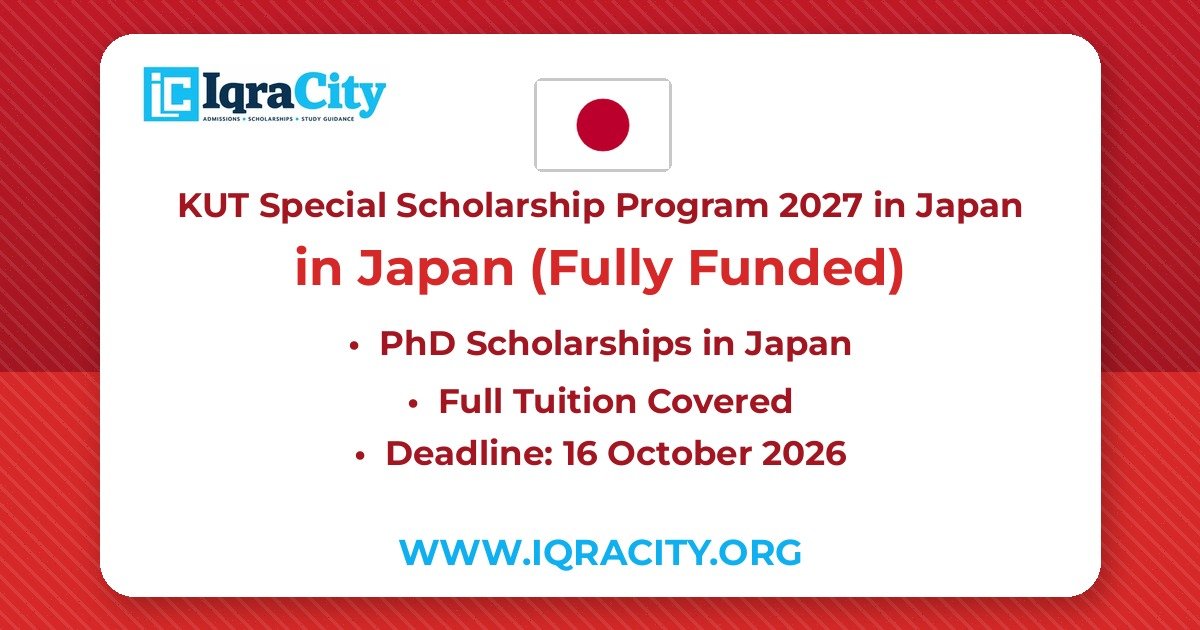
Few scholarships are as straightforward as this one: a three-year, English-taught PhD in Japan with every major fee waived and a monthly stipend of ¥150,000 — roughly a million Pakistani rupees a year in living support. The KUT Special Scholarship Program (SSP) at Kochi University of Technology (KUT) exists for one purpose: to bring capable doctoral researchers into KUT's labs and keep them there for three years of serious research. There's one catch that trips up a lot of applicants — you cannot apply at all until a KUT professor has personally agreed to supervise you. Get that permission, and the rest of the process is clearly laid out. With the deadline for April 2027 enrollment just days away, here's everything you need.
In short: KUT's Special Scholarship Program funds a 3-year English-medium PhD in engineering and related fields for international researchers: full tuition, enrollment, and exam-fee waivers plus ¥150,000/month for three years. You must first get permission from a KUT supervisor (apply for that now — it takes time). Formal application deadline: 16 October 2026 for April 2027 and first-round October 2027 enrollment; a second round for October 2027 entry closes 9 April 2027.
Quick Overview
- Host Country: Japan
- Host Institution: Kochi University of Technology (KUT), Graduate School of Engineering
- Degree Level: Doctoral (PhD) — Doctor of Philosophy in Engineering or Doctor of Philosophy
- Program Duration: 3 years (English medium)
- Funding Type: Fully funded (all fees waived + monthly stipend)
- Deadline: 16 October 2026 (for April 2027 enrollment and first-round October 2027 enrollment); 9 April 2027 (second round for October 2027 enrollment). Documents must *arrive at KUT* by the deadline — post counts, not online submission.
Benefits of the KUT Special Scholarship Program
This is one of the genuinely fully funded PhD scholarships in Japan — the official guidelines spell out every line item:
- Full tuition waiver for three years — Annual tuition of ¥535,800 is waived in full, along with the ¥300,000 enrollment fee and the ¥15,000 entrance examination fee.
- ¥150,000 monthly stipend for three years — Paid as a scholarship for research project work, every month for the full three-year term — about ¥5.4 million in living support over the programme.
- One-time ¥150,000 travel and settling-in grant — Given to international applicants living outside Japan who enter with (or intend to acquire) "Student" residence status.
- English-medium doctoral education — All research and coursework in English; plus English academic-writing classes in the first two years taught by a native-English professor.
- Japanese language and cultural support — Japanese conversation and grammar classes, tutors for academic and daily-life matters, seasonal cultural activities, and help finding single accommodation (including KUT's International House at the Kami campus, subject to vacancy).
- Online selection — The interview and specialized-subject examination are conducted online (typically via Webex), so you don't fly to Japan for the exam.
- Research obligations that build your career — You'll report research achievements to the Graduate School dean each semester and are expected to publish in high-level peer-reviewed journals — the kind of record that makes post-PhD careers.
Two honest notes: newly admitted foreign doctoral students pay about ¥33,000 for insurance plus a ¥10,000 alumni association fee, and accommodation costs are your own (KUT helps you *find* it, not pay for it).
Eligibility Criteria for the KUT Special Scholarship Program
KUT lists six conditions, and you must meet all of them:
- Supervisor permission first — You must have the agreement of your preferred SSP supervisor *before* you can formally apply. This is a hard gate, not a formality: without it, there is no application. You may approach up to two supervisors through the online pre-application, but must choose one for the formal application.
- Master's degree or equivalent — A degree comparable to a KUT master's after 18 years of education, or be on track to complete one before enrollment. If you're still finishing, you'll need to produce the verified certificate before enrollment is finalized.
- 35 years old or under at enrollment, in principle — The guideline says "in principle," so borderline cases aren't automatically excluded — but treat 35 as the real line.
- Strong academic record — Excellent bachelor's and master's results from reputable universities. Meeting the minimum alone rarely wins this — it's competitive.
- Research capability and intent — Genuine knowledge, skill, and motivation in the supervisor's research field. Read the supervisor's recent papers before you write to them.
- High English proficiency — Official minimums: TOEFL iBT 72 (Writing 17), IELTS 5.5 (Writing 5.5), CET-6, or WSK (PETS-5). Some applicants may be exempt from submitting scores under certain conditions (for example, prior English-medium education — check the guidelines).
How to Apply for the KUT Special Scholarship Program
The process has two phases — permission first, paperwork second:
1. Choose your supervisor(s). Browse the official SSP supervisor list and pick up to two professors whose research genuinely matches yours. Read their publications; your outreach will be judged on how well you understand their work. Start this at least 8 weeks before the formal deadline — though with the October deadline near, move fast. 2. Submit the online pre-application request. Fill in KUT's Online Pre-Application Form, which is sent to your chosen supervisors. Important: if a supervisor doesn't reply within two weeks, your pre-application is considered rejected — follow up politely, and don't keep waiting. 3. Respond promptly when contacted. If a supervisor wants to proceed, reply quickly. You can only formally apply if they agree. 4. Select one supervisor and prepare documents. Even if both supervisors agree, you must choose exactly one for the formal application. Then assemble the full document set. 5. Post the documents to KUT. The formal application goes by *post*, and everything must *arrive at KUT* by the deadline — allow generous mailing time, or consider courier. 6. Screening and online exam. Between October and November 2026 (for this round), KUT screens documents, then conducts an interview and a specialized-subject exam, usually online via Webex. You may be rejected at the document stage before any interview. 7. Decision and registration. Admission decisions for this round come around mid-December 2026; the registration deadline is 15 January 2027.
Required Documents
Per the official guidelines, prepare the items on KUT's required-documents checklist — typically including:
- Completed SSP application forms
- Academic transcripts (bachelor's and master's)
- Bachelor's and master's degree certificates (or proof of expected completion)
- English proficiency certificate (per the minimums above, unless exempt)
- Curriculum vitae / resume
- Research proposal aligned with your chosen supervisor's field
- Proof of supervisor permission
- Passport copy and photograph
- Photo ID (passport or government-issued ID with photo) ready to show at the start of the online interview
Always work from the current official checklist — requirements can vary with your academic background.
KUT Special Scholarship Program Deadline
The timeline is tight but real: all documents must reach KUT by 16 October 2026 for April 2027 enrollment (second deadline) and for the first round of October 2027 enrollment. Screening follows in October–November 2026, decisions around mid-December 2026, registration by 15 January 2027. Missed this window? There is a second chance: 9 April 2027 is the deadline for the second round of October 2027 enrollment (screening April–May 2027, decisions mid-June 2027, registration by 9 July 2027). Because supervisor permission takes weeks, start contacting professors *now* even if you're aiming for the April 2027 round.
Frequently Asked Questions
Is the KUT Special Scholarship really fully funded?
Yes — tuition (¥535,800/year), the ¥300,000 enrollment fee, and the ¥15,000 exam fee are all waived for three years, plus ¥150,000/month and a one-time ¥150,000 travel grant for international applicants from outside Japan. The honest fine print: insurance (~¥33,000) and alumni dues (~¥10,000) are yours, and you pay your own accommodation.
Can I apply without a supervisor's permission?
No. KUT is explicit: only individuals who have obtained their preferred supervisor's permission are eligible to formally apply. This is the step where most applications die — treat finding a supervisor as the real application, and the paperwork as the follow-through.
What if my supervisor doesn't reply to my pre-application?
KUT treats a pre-application as rejected if there's no reply within two weeks of submission. Move on to another supervisor — that's exactly why you can approach two.
Do I need to know Japanese?
No. The doctoral programme is entirely in English. KUT provides Japanese classes for daily life, but Japanese is not an admission requirement.
Which research fields are covered?
Across KUT's campuses: Intelligent Mechanical and Aerospace Engineering, Electronic and Photonic Engineering, Architecture and Infrastructure Design, Engineering Science, Informatics, Data and Innovation (Kami and Eikokuji campuses), and Economics and Management (Eikokuji campus). Economics and Management students research at the Eikokuji campus in downtown Kochi City, about an hour from the main Kami campus.
Can Pakistani students apply?
Yes — the SSP is open to all nationalities, and international applicants living outside Japan get the extra ¥150,000 travel grant. Eligibility is about your academic record, research fit, and English, not your passport.
How competitive is the SSP?
Very. Each supervisor can host no more than three SSP students concurrently, so places are genuinely limited. A strong master's record, a research proposal that fits the supervisor's lab, and clear English writing are what separate winners.
Do I have to travel to Japan for the exam?
No. The interview and specialized-subject examination are conducted online, usually via Webex. Just have a photo ID ready to show at the start.
What degree will I get?
Doctor of Philosophy in Engineering or Doctor of Philosophy, depending on your research field — after at least three years of enrollment, 10+ doctoral credits, a preliminary examination, a final public defense, and at least one high-level peer-reviewed publication.
Can I reapply if I'm rejected?
The guidelines don't forbid reapplication, and there are two enrollment intakes a year. If you're rejected at the supervisor stage, a stronger research proposal and better-matched supervisor choice are the usual fix — and the April 2027 round is your next window.
Final Words
The SSP is one of Japan's cleanest fully funded PhD offers — no tuition games, no vague promises, just a monthly stipend and a lab that wants you. The entire battle is won or lost in the supervisor outreach. Read their papers, write like a researcher, and start today: the October 16 deadline is closer than the calendar makes it feel.
Related Scholarships
More opportunities you may also qualify for:
- Tokyo City University Scholarship 2026 in Japan (Master's & PhD Funding) · Japan • Fully Funded
- University of Tokyo MEXT Scholarship 2027 in Japan | Fully Funded · Japan • Fully Funded
- ADB-Japan Scholarship Program 2027: Fully Funded Master's in Asia-Pacific · Japan • Fully Funded
- Western Balkans Meet Japan 2027 | Fully Funded Youth Exchange Program · Japan • Fully Funded