Let's be straight about this one from the start: the FAO Volunteer Programme is not a scholarship, not a paid job, and not a holiday in Rome. It's a volunteer assignment with the Food and Agriculture Organization of the United Nations — and that's exactly why it's valuable. You get up to six months working inside one of the world's most important UN agencies, side by side with professionals fighting hunger and food insecurity, and you leave with experience that changes how employers look at your CV.
FAO does not pay volunteers a salary. What you get instead is practical, professional exposure in an international environment — research projects, programme implementation, data work, reports, and knowledge-sharing, all connected to FAO's Strategic Framework and the UN Sustainable Development Goals. For anyone eyeing a career in development, agriculture, nutrition, or the UN system, this is one of the most accessible doors in.
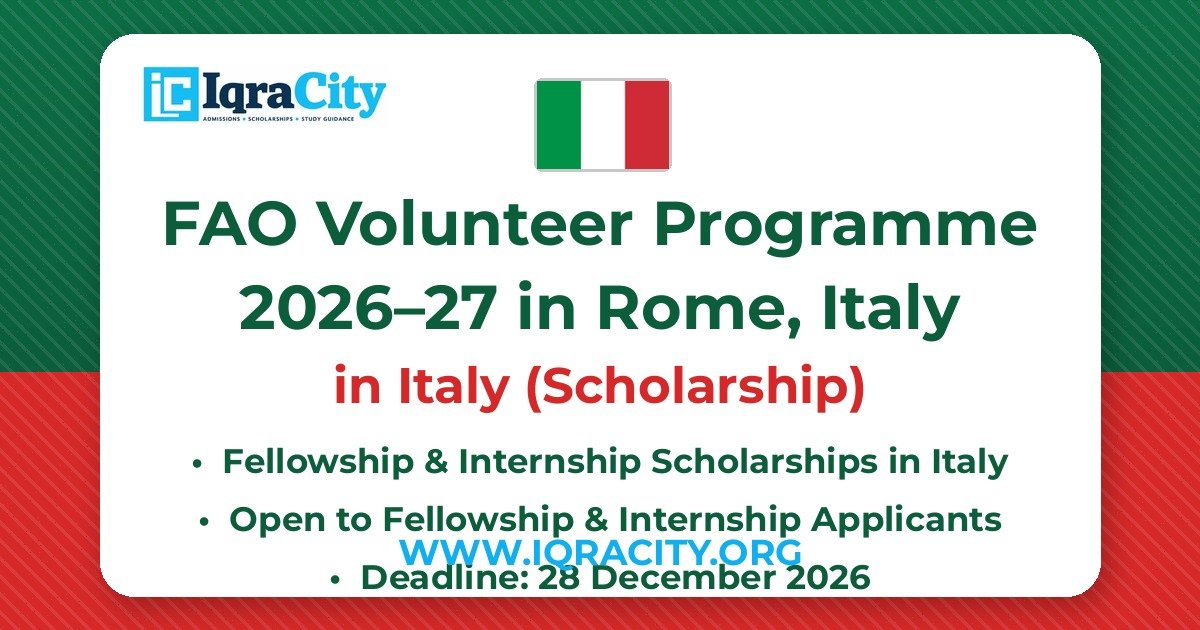
In short: The FAO Regular Volunteer Programme 2026–27 offers up to six months of volunteer assignments at FAO headquarters in Rome, Italy. It's unpaid but fee-free, open to nationals of FAO member countries aged 18+ with secondary school education and working knowledge of an FAO language. Applications close on 31 December 2026.
● Applications Open
Quick Overview
- Host Country: Italy
- Host Institution: Food and Agriculture Organization of the United Nations (FAO), Headquarters — Rome
- Degree Level: Open to all (minimum: completed secondary school education)
- Program Duration: Up to 6 months
- Funding Type: Unpaid volunteer programme (no remuneration, no application fees)
- Deadline: 31 December 2026, 10:59 PM (Rome time)
Benefits of the FAO Volunteer Programme
Honesty first: there is no salary and no stipend. But calling this opportunity "unpaid" and leaving it there would miss the point. Here's what you actually gain:
- Work inside a UN specialized agency — Contribute directly to FAO's mission of ending hunger, malnutrition, and food insecurity.
- Professional experience that counts — Assignments run up to six months and involve real work: supporting research and technical projects, programme implementation, data collection and analysis, reports, and knowledge-sharing.
- An international work environment — Work under an assigned FAO supervisor alongside professionals from around the world.
- SDG-linked experience — Everything connects to FAO's Strategic Framework and the UN Sustainable Development Goals — exactly the language development-sector employers want to see.
- Zero fees, ever — FAO does not charge any application or recruitment fee at any stage. Anyone asking you for money in FAO's name is a fraud.
- Career signal — UN volunteer experience is one of the strongest signals for entry into the UN system, NGOs, and development agencies.
Eligibility Criteria for the FAO Volunteer Programme
FAO keeps the eligibility requirements deliberately simple — the bar is about motivation and basic qualifications, not elite credentials:
- Nationality — You must be a national of an FAO Member country (almost every country in the world is a member).
- Age — You must be 18 years or older at the time of application. There is no upper age limit.
- Education — You must have completed secondary school education. University students, graduates, and professionals are all welcome.
- Languages — Working knowledge of at least one FAO official language: Arabic, Chinese, English, French, Russian, or Spanish. Knowledge of a second FAO language is an asset.
- Skills — You should be able to adapt to an international, multicultural environment, have good communication skills, and be comfortable with basic computer programmes.
- Experience — Relevant work or research experience in one of FAO's working domains strengthens your application.
- Residence/visa status — You must have appropriate residence or immigration status in the country of assignment (Italy, for HQ assignments) before joining.
- Family relation — Candidates with a parent, sibling, son, or daughter employed by FAO under any contractual arrangement are not eligible.
FAO actively encourages applications from women, nationals of non- and under-represented member countries, persons with disabilities, and candidates from Least Developed Countries, Low-Income Food-Deficit Countries, Landlocked Developing Countries, and Small Island Developing States.
How to Apply for the FAO Volunteer Programme
Applications go through FAO's official online recruitment portal — never through email, agents, or third parties:
1. Visit the official FAO Volunteer Programme page and find the current "Call for Expression of Interest." 2. Create your candidate profile on the FAO careers portal if you don't have one already. 3. Fill in your profile completely — personal information, education, language skills, employment history, and certifications. Applications are screened on the strength of this profile. 4. Attach a strong letter of motivation explaining why you want to volunteer with FAO and what you can contribute. 5. Upload copies of your academic qualifications and any supporting attachments. 6. Review your application carefully and submit it before the closing date of the call. 7. Only selected candidates will be contacted. If you are not selected before the closing date, you can re-apply to new calls to stay in consideration.
Required Documents
Per the official vacancy announcements, prepare the following:
- Letter of motivation
- Copies of academic qualifications
- A complete online candidate profile (employment history, education, language skills, certifications)
FAO Volunteer Programme Deadline
The current call for the FAO Regular Volunteer Programme at HQ Rome closes on 31 December 2026 at 10:59 PM. If you miss this deadline, your application won't be considered for this call — but FAO runs volunteer calls on a recurring basis, so check the careers portal for new expressions of interest. One practical tip: don't leave it to the last day. The portal gets heavy traffic near closing dates, and an incomplete profile is the most common reason good candidates get screened out.
Frequently Asked Questions
Is the FAO Volunteer Programme really unpaid?
Yes. FAO states this clearly on its official page: no remuneration is provided to regular volunteers. You are volunteering your time and skills. You cover your own travel, accommodation, and living costs in Rome — so go in with a realistic budget, not with the expectation of a paid placement.
Is it really free to apply?
Completely free. FAO does not charge any fee at any stage of the recruitment process. If anyone contacts you asking for a "processing fee" or "placement fee" for an FAO volunteer position, it's a scam — report it and walk away.
Do I need a university degree?
No. The minimum requirement is completed secondary school education. That said, assignments are matched to FAO's work areas — agriculture, nutrition, economics, data, communications — so relevant education or experience makes your application stronger.
Where will I be placed?
The current call places volunteers at FAO headquarters in Rome, Italy. You'll be assigned to a field related to FAO's work under the supervision of an assigned FAO supervisor. FAO also runs volunteer opportunities in other offices, advertised through separate calls.
How long does the assignment last?
Up to six months. The exact duration depends on the hosting office's needs and the terms of reference for your assignment.
Do I need to speak Italian?
Not necessarily. You need working knowledge of at least one FAO official language (Arabic, Chinese, English, French, Russian, or Spanish). English is the main working language at HQ, but a second FAO language is a genuine asset.
Do I need a visa for Italy?
Yes — you must have appropriate residence or immigration status in the country of assignment before joining. FAO will not sort your visa out of thin air; non-EU nationals should research the Italian volunteer/stay permit process early, because it takes time.
Can family members of FAO staff apply?
No. If your mother, father, sister, brother, daughter, or son is employed by FAO under any type of contract, you are not eligible for the Regular Volunteer Programme.
What kind of work will I actually do?
It depends on the hosting office, but typical tasks include supporting research and technical projects, assisting with programme implementation, data collection and analysis, preparing reports and documentation, and supporting knowledge-sharing initiatives.
Will this help me get a job at the UN?
It helps a lot, though it guarantees nothing. UN volunteer experience is widely respected across the development sector and gives you insider knowledge, professional references, and a network inside the system. Many FAO volunteers go on to internships, consultancies, and staff roles — treat the six months as an extended interview for your career.
Final Words
The FAO Volunteer Programme won't pay your rent in Rome, and you should be clear-eyed about that before applying. But if you can fund yourself for up to six months, there are few better investments in a development career than working inside a UN specialized agency on the fight against hunger. The application is free, the requirements are accessible, and the experience is real. Apply before 31 December 2026 — and write a motivation letter that shows you actually care about food security, not just the UN logo.
Related Scholarships
More opportunities you may also qualify for:
- Harvard Berenson Fellowship 2027-28 in Italy: Fully Funded Research Fellowship · Italy • Fully Funded
- TWAS-SISSA-Lincei Research Cooperation Visits 2026 in Italy (Funded) · Italy • Fully Funded
- EUI Jean Monnet Fellowships 2027 in Italy | Fully Funded Research Fellowship · Italy • Fully Funded
- Princeton Fung Global Fellows Program 2027–28: A Paid Research Year at Princeton for Early-Career Scholars · USA • Scholarship