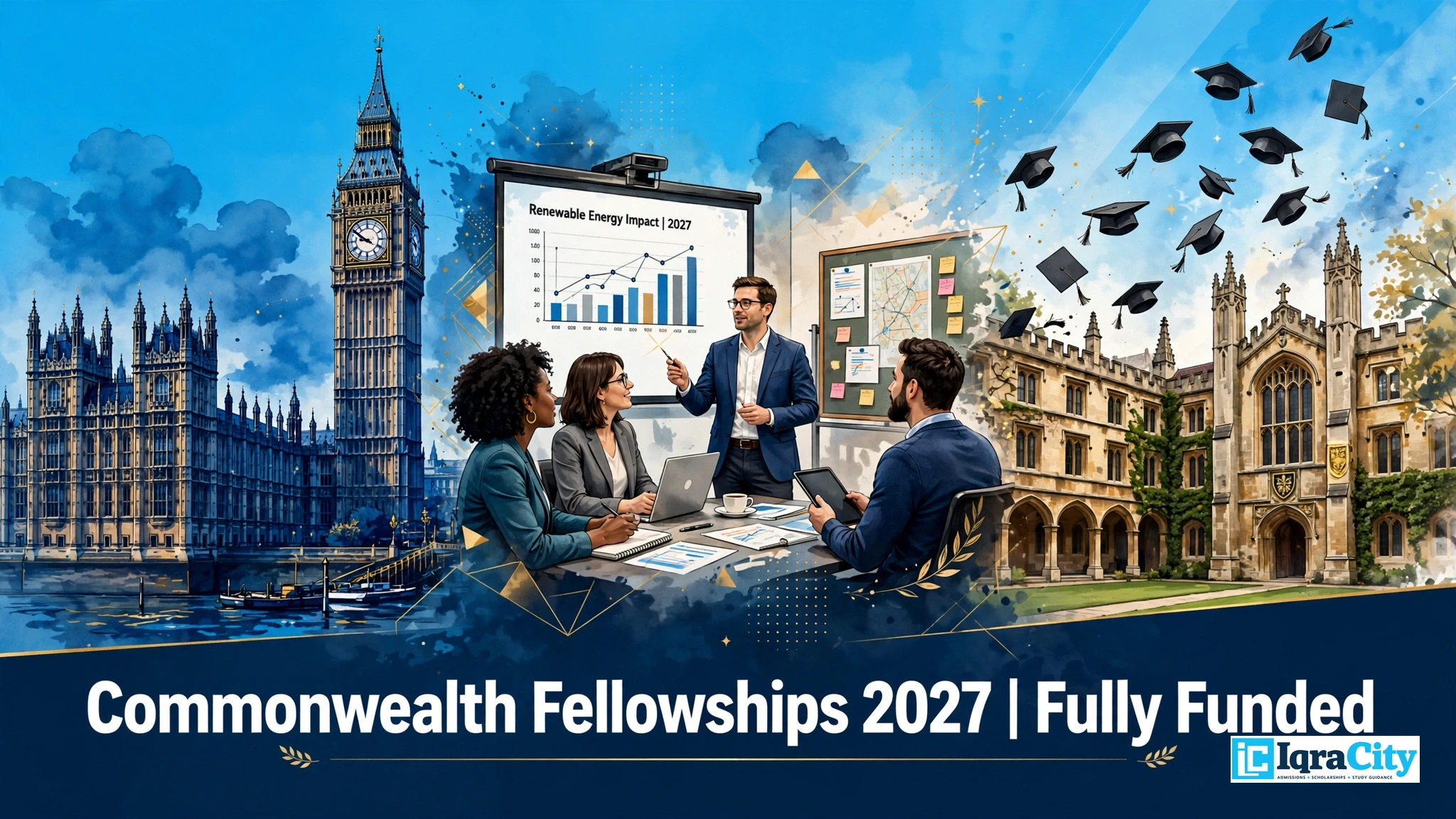
Three years of doctoral research at a UK university — tuition, flights, living stipend, even fieldwork and a mid-term trip home — all paid for. The Commonwealth PhD Scholarships, run by the Commonwealth Scholarship Commission and funded by the UK Foreign, Commonwealth & Development Office (FCDO), are designed for high-calibre graduates from the Commonwealth's least developed countries and vulnerable states whose research could genuinely move the needle on development back home. This isn't a generic study-abroad grant; it's aimed at people who will become leaders, teachers, and researchers in their countries. The research proposal is the centerpiece of the whole application, so this one rewards applicants who already know what they want to investigate and why it matters.
In short: The Commonwealth PhD Scholarship 2027-28 funds 36 months of full-time doctoral study at a UK university for graduates from 17 eligible Commonwealth countries. It covers full tuition, return airfare, a stipend of £1,712 per month (£2,000 in London), plus fieldwork and family allowances. Applications close at 16:00 BST on 20 October 2026, and you apply through CSC Central and your country's nominating agency.
Quick Overview
- Host Country: United Kingdom
- Host Institution: Any approved UK university (with a CSC part-funding agreement)
- Degree Level: PhD (full-time doctoral research)
- Program Duration: 36 months
- Funding Type: Fully funded — tuition, return airfare, monthly stipend, fieldwork, family allowances
- Deadline: 20 October 2026, 16:00 BST (applications opened 8 September 2026)
Benefits of the Commonwealth PhD Scholarships 2027
This is comprehensive funding — built around the reality that doctoral research involves fieldwork, conferences, and sometimes a family in tow.
- Full tuition coverage — approved tuition fees are covered by agreement between the CSC and your UK university; you pay nothing towards fees.
- Return airfare — approved economy airfare from your home country to the UK and back at the end of your award (not for dependants, and not for journeys made before the award is confirmed).
- Monthly living stipend — £1,712 per month, or £2,000 per month at universities in the London metropolitan area (rates quoted at current levels).
- Study travel grant — towards the cost of study-related travel within the UK or overseas.
- Fieldwork support — where approved, one economy-class return airfare to your fieldwork location for research undertaken overseas.
- Paid mid-term visit — a return airfare to your home country partway through the award, unless you've claimed spouse/child allowances or received a fieldwork airfare.
- Family allowances — a spouse with no children gets £313 per month for up to nine months; a spouse with children gets £313 per month plus £313 per month for the first child and £154 per month for the second and third child under 16; widowed, divorced, or single parents get £622 per month for the first child and £154 per month for the second and third under 16 (conditions apply, and everyone must be living together at the same UK address).
- Disability support — a full assessment of needs and eligibility for additional financial support is offered if you share that you have a disability.
- No application fee — applying is free. Anyone asking for payment to process your application is running a scam.
Eligibility Criteria for the Commonwealth PhD Scholarships 2027
Note that this strand is narrower than the Master's one — it's specifically for applicants from least developed countries and vulnerable states (as classified by the OECD Development Assistance Committee), not all Commonwealth countries.
- Eligible nationality — you must be a citizen of, or have been granted refugee status by, an eligible Commonwealth country, or be a British Protected Person.
- Permanent residence — you must be permanently resident in an eligible Commonwealth country.
- Academic standing — by September 2027, hold a first degree of at least upper second-class (2:1) honours standard, or a lower second-class (2:2) degree plus a relevant postgraduate qualification (usually a Master's degree).
- Not already a doctoral student — you must not be registered for a PhD, or an MPhil leading to a PhD, before September/October 2026 (at a UK university or in your home country).
- Available to start — able to begin your studies in the UK by the start of the UK academic year in September 2027.
- Financial need — unable to afford to study in the UK without this scholarship.
- Full-time commitment — the award covers 36 months of full-time study only. The CSC does not support four-year PhDs, and no other course may be undertaken at the same time.
- No age limit, no IELTS — the CSC sets no age limit and doesn't require an English language test, though your university's admission process may.
Eligible countries: Bangladesh, The Gambia, Kiribati, Lesotho, Malawi, Mozambique, Nigeria, Pakistan, Rwanda, Sierra Leone, Solomon Islands, Sri Lanka, Tanzania, Togo, Tuvalu, Uganda, and Zambia. If your country isn't on this list, check whether it's eligible for the Commonwealth Master's strand instead — the Master's list is much wider.
How to Apply for the Commonwealth PhD Scholarships 2027
Like the Master's strand, there are two parallel applications — the CSC's and your nominator's — and skipping either one sinks you.
1. Confirm eligibility and start your research proposal. The quality of your research proposal is one of the three published selection criteria, so this isn't something to draft the night before. Your proposed study must fit a 36-month tenure, connect to one of the six CSC development themes, and show clear developmental relevance for your home country. 2. Find a potential supervisor and secure their support. This is the PhD-specific step that catches people out: you must provide a supporting statement from a proposed supervisor in the UK from at least one of the institutions you name on the form. The supervisor confirms they're prepared to take you on, that the facilities exist for your research, how your plan fits their department's expertise, how much of your plan they helped write, and that it can be completed within 36 months. Strongly advised: get this from your first-choice university. 3. Identify your nominator. Apply through your country's national nominating agency (the main route) or a selected NGO/charitable body. The CSC accepts no direct applications. Each nominator has its own selection process, possibly extra eligibility criteria, and often a closing date earlier than the CSC's — find it now. 4. Shortlist three universities and supervisors. List three universities and supervisors in order of preference with your reasons. The CSC won't change these after selection, so include genuine second and third choices — without them, the scholarship may not proceed if your first choice can't place you. 5. Apply for university admission in advance. Many UK doctoral programmes have strict admission deadlines. If you're selected but haven't applied and been accepted, the scholarship may not go ahead. 6. Register on CSC Central and draft offline. The CSC's online system uses two-factor authentication (smartphone or second email). The CSC provides a template application form and guidance document — draft everything offline first: qualifications, up to 10 publications and prizes, employment history and its relevance, your Development Impact statement (four parts: development issues at global/national/local level and your theme; how you'll apply your skills afterwards; expected changes with outcomes, timeframe, and beneficiaries; how impact will be measured), award objectives, five-year and long-term career plans, detailed plan of study, personal statement, and voluntary/leadership activities. 7. Line up referees. Three referees are named on the form (one should be your current employer if applicable), and at least two signed references — on institutional letterhead or an email clearly showing the sender's details, uploaded as PDFs — must be included by the deadline. 8. Submit by 16:00 BST on 20 October 2026. Save constantly (a browser refresh loses unsaved data), never rely on the last day — the system is notoriously busy — and remember nothing can be edited after submission. Nominators forward candidates to the CSC by December 2026; a nomination is no guarantee of selection; expect to hear by July 2027.
Required Documents
Upload everything through CSC Central — the CSC will not accept documents by email or any other route, and anything missing at the deadline makes the application ineligible.
- Copy of a valid passport or national ID card showing your photograph, date of birth, and country of citizenship.
- Full transcripts for all higher education qualifications, including to-date transcripts for any course currently being studied, with certified translations if not in English. Missing pages mean an ineligible application — check every page.
- References from at least two individuals, in PDF format, signed, and on institutional letterhead or an email clearly showing the sender's details.
- A supporting statement from a proposed UK supervisor, in PDF format, signed, and on institutional letterhead or an email clearly showing the sender's details, from at least one of the institutions named on your application form.
Commonwealth PhD Scholarships 2027 Deadline
The CSC deadline is 16:00 BST on Tuesday, 20 October 2026, for doctoral study beginning September/October 2027. There are no extensions and no late submissions. But the date that actually matters may be earlier: your national nominating agency runs its own selection and sets its own deadline, and agencies must submit their nominees to the CSC by December 2026. Plan backwards from your agency's cut-off, not the CSC's — plenty of strong candidates have lost out simply because they never checked the second deadline.
Frequently Asked Questions
Is the Commonwealth PhD Scholarship fully funded?
Yes — genuinely. Full tuition, return airfare, a monthly stipend (£1,712, or £2,000 in London), study travel grants, approved fieldwork airfare, a paid mid-term visit home, and family allowances where applicable. It's one of the most complete PhD funding packages available for international researchers.
How is this different from the Commonwealth Master's Scholarship?
Three big differences: the PhD strand is only for 17 least developed and vulnerable Commonwealth states (the Master's covers 42 countries); it funds 36 months of full-time doctoral research rather than a one-year taught degree; and it requires a research proposal plus a supporting statement from a UK supervisor — the application is research-driven, not course-driven.
Do I need a research proposal before applying?
Yes, and it matters enormously. Quality of the research proposal is one of the three official selection criteria (alongside candidate merit and development impact). Your plan of study must be completable within the 36-month tenure — the CSC doesn't support four-year PhDs — and you won't be able to change it significantly after selection without CSC agreement.
Do I need to contact a UK supervisor before I apply?
Effectively, yes. You must upload a supporting statement from a proposed supervisor at one of your named universities, confirming they're prepared to work with you, have the facilities for your research, and that your plan fits their department. It's strongly advised to get this from your first-choice university — the CSC reserves the right to place you at a different university if only that one provides a statement.
I'm already doing an MPhil that leads to a PhD. Can I apply?
No. If you're registered for a PhD, or an MPhil leading to a PhD, before September/October 2026 — whether in the UK or your home country — you're not eligible. This scholarship is for people starting fresh doctoral study.
Do I need IELTS?
Not for the CSC — the Commission doesn't require an English test from any applicant. Your chosen universities will have their own language requirements for admission, though, so check those separately.
Can I work part-time during the PhD?
Not freely. Scholars must not undertake paid employment without CSC approval in advance, must reside in the UK throughout the award, and need CSC approval for overseas travel. Plan on the stipend being your income.
Can I bring my spouse or children?
Yes, with allowances: £313/month for a spouse alone (up to nine months); spouse plus children adds £313/month for the first child and £154/month for the second and third under 16; single parents get £622/month for the first child. The CSC is upfront that these are only a contribution — the true costs are considerably higher, and you'll need to supplement them. Dependants' airfares are never reimbursed.
Can I stay in the UK after my PhD?
No — not on this scholarship's terms. Scholars sign an undertaking to return home after the award, and the CSC won't support switching to a graduate or other visa to stay and work or do postdoctoral research. The whole point is building research capacity back home.
How competitive is it?
Extremely. You're competing with strong graduates across 17 countries for a limited number of awards, judged on academic merit, research proposal quality, and the development impact of your work. The realistic advice: invest your effort in the research proposal and the Development Impact statement — that's where selections are actually won and lost.
Final Words
If you already have a research question burning a hole in your notebook and a home country that needs the answer, this scholarship was designed for you. Get the supervisor statement early, respect both deadlines (your nominator's and the CSC's), and give the research proposal the weeks — not days — it deserves.