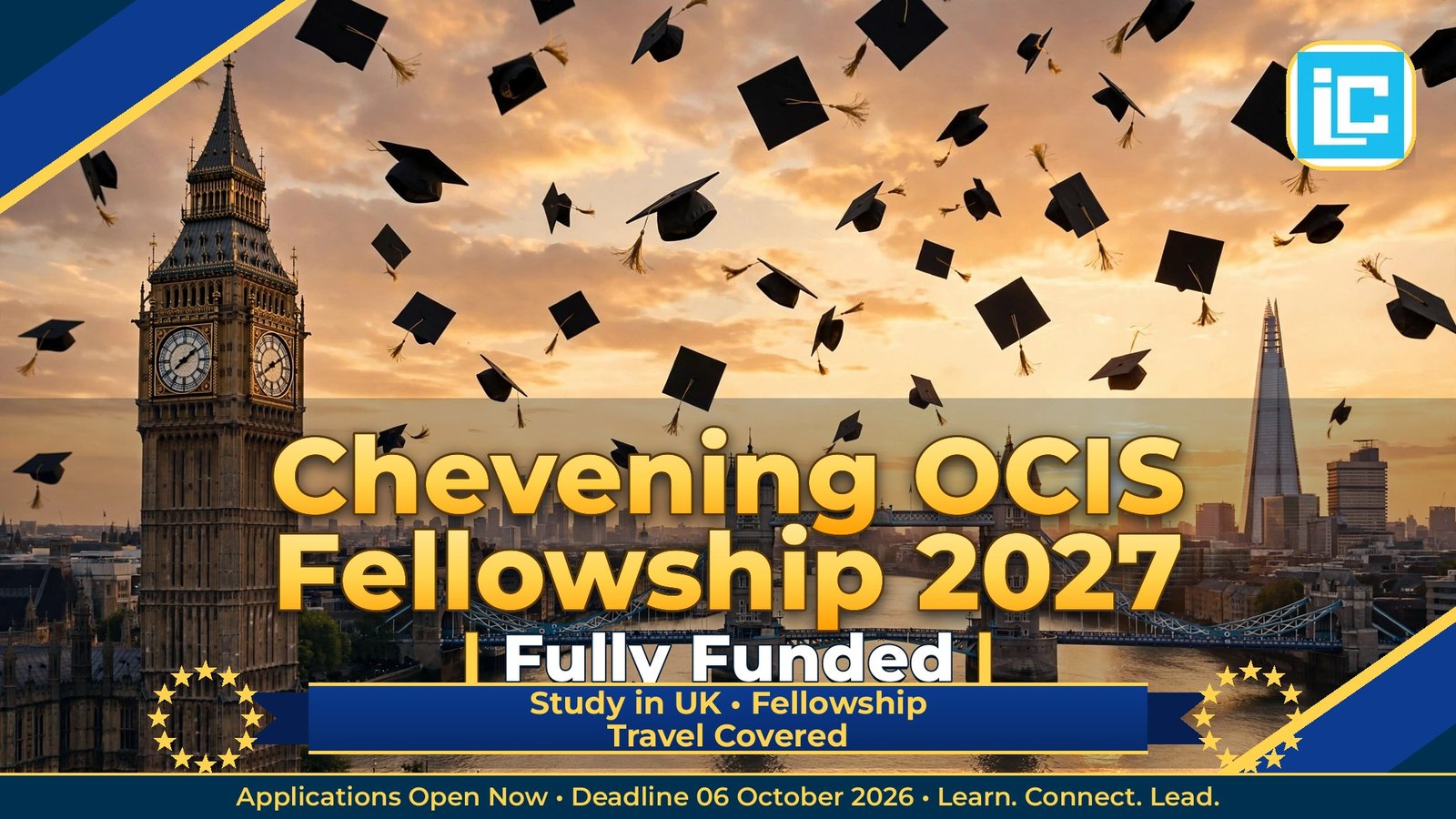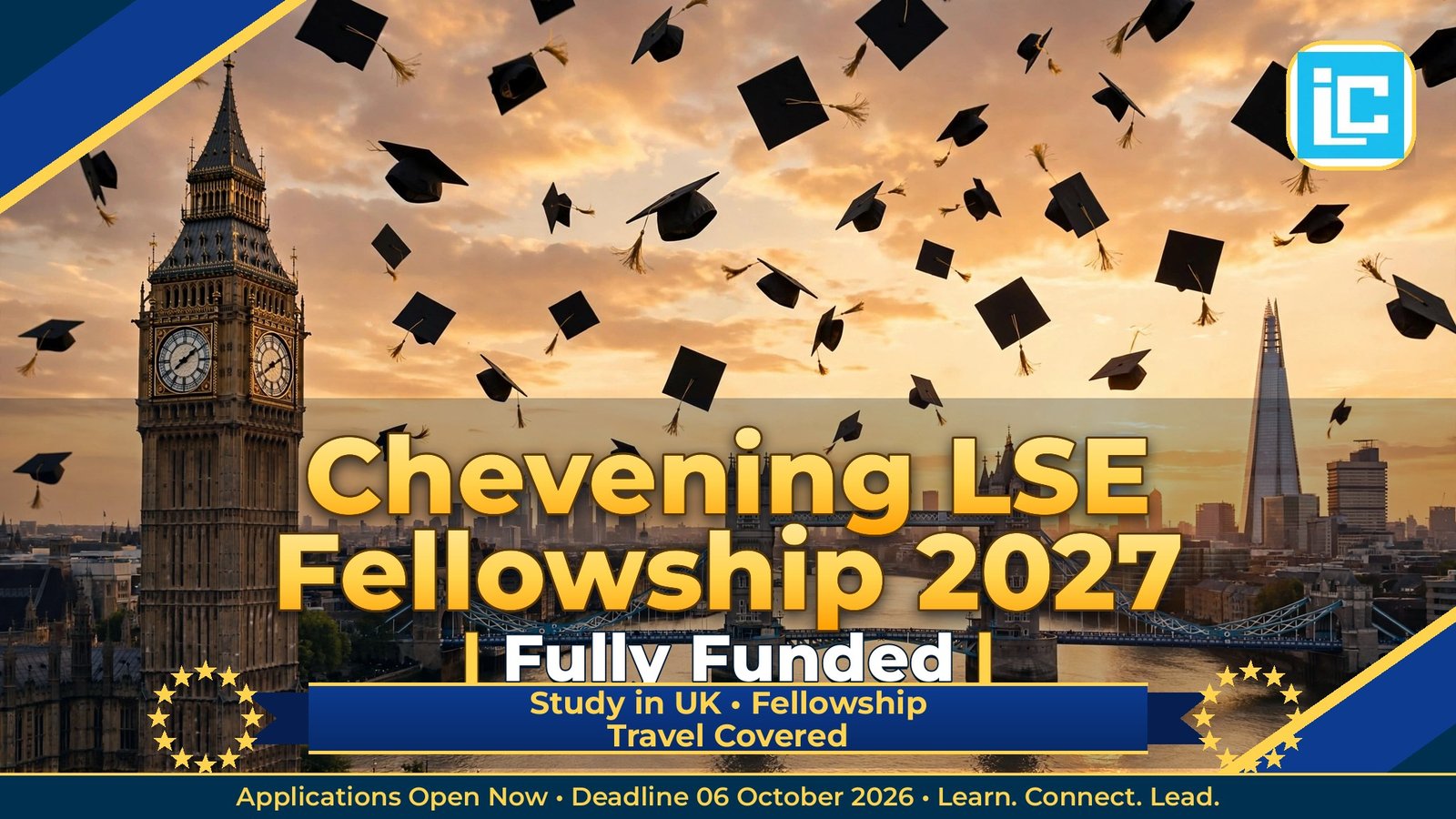
A master's degree in the UK can easily cost £15,000–£30,000 in tuition alone — before rent, food, and the flight. That's why so many brilliant students never apply. But there is a genuine way around it: the Chevening Scholarship, funded by the UK government, pays for a full one-year master's degree at any UK university for future leaders from more than 160 countries. Tuition, a monthly living stipend, your flights, your visa, even your TB test — covered. No IELTS requirement, no age limit, no application fee. The catch? You need two years of work experience, a sharp application, and the discipline to hit the deadline: 6 October 2026 at 11:00 UTC. This guide walks you through exactly how Chevening works and how to become the kind of applicant it selects.
In short: Chevening is the UK government's fully funded scholarship for a one-year taught master's in the UK, open to citizens of 160+ countries with two years (2,800 hours) of post-degree work experience. It covers full tuition, living allowance, flights, and visa. Applications for the 2027-28 cycle close on 6 October 2026 at 11:00 UTC.
● Applications Open
Quick Overview
- Host Country: United Kingdom
- Host Institution: Any UK university offering an eligible one-year taught master's
- Degree Level: Master's (one-year taught postgraduate)
- Program Duration: 9–12 months, starting September/October 2027
- Funding Type: Fully funded by the UK Foreign, Commonwealth & Development Office (FCDO)
- Deadline: 6 October 2026, 11:00 UTC (applications opened 4 August 2026)
Benefits of the Chevening Scholarship
"Fully funded" gets thrown around a lot. Chevening's version is one of the most complete packages in the world:
- Full tuition fees — for an eligible one-year master's course. One honest caveat: if you choose an MBA, any tuition above £22,000 is your own responsibility.
- Monthly living stipend — a personal allowance covering accommodation and living costs, set at a higher rate if you study in London.
- Economy travel to and from the UK — by an approved route, booked through the programme.
- UK visa application cost — your entry-clearance fee is paid.
- Arrival and homeward departure allowances — lump sums to help you settle in and get home.
- Travel top-up allowance and event grants — funding toward attending Chevening's networking and leadership events during your year.
- TB test costs — up to £75 where a test is required for your visa.
- The network itself — access to Chevening's global community of 55,000+ alumni across 160+ countries, plus exclusive events throughout your year. For many scholars, this is the benefit that keeps paying for decades.
Eligibility Criteria for the Chevening Scholarship
Chevening is strict and literal about eligibility — missing one rule means automatic rejection:
- Citizenship of an eligible country or territory — Chevening runs in 160+ countries and territories; check your country on the official site. Some territories have their own dedicated award.
- Return commitment — you must agree to return to your country of citizenship for at least two years after your scholarship ends. This is the heart of the programme's mission: developing leaders who go home.
- Undergraduate degree — a degree that qualifies you for admission to a UK master's programme, completed at least two years before the application deadline. Your certificate is required by the interview stage.
- Work experience: 2,800 hours — at least two years of post-degree work experience. The hours matter more than the calendar: full-time jobs, part-time jobs, voluntary work, and internships all count, as long as the experience came after your undergraduate studies.
- Three eligible course choices — you must apply to three different eligible UK university courses (full-time, UK-based, taught master's lasting 9–12 months), and hold an unconditional offer from at least one of them by 8 July 2027, 17:00 BST.
- No age limit — there is genuinely no upper age limit.
- No Chevening English test — Chevening itself requires no IELTS or other test score. Your chosen university's admission rules still apply, so check those separately.
- Who cannot apply — British or dual British citizens (with limited exceptions), anyone resident in the UK at application time, staff of UK government departments, the British Council or a partner UK university (and their close relatives), former staff of these bodies who left within the last two years, and anyone who has previously studied in the UK on a UK government-funded scholarship.
How to Apply for the Chevening Scholarship
1. Check your eligibility properly — confirm your country is eligible, calculate your work hours (you need a full 2,800), and verify your degree was completed at least two years before 6 October 2026. 2. Shortlist three eligible master's courses — three different courses, each full-time, UK-based, 9–12 months, starting in autumn 2027. Spread them across universities sensibly. 3. Write the four essays — the application asks for leadership, networking, studying in the UK, and career plan. Use concrete examples, not adjectives. Weak, generic essays are the single biggest reason strong candidates fail. 4. Register and complete the online application — everything goes through Chevening's official online system. Fill it in English; there is no application fee. 5. Apply to the three universities separately — Chevening does not apply for you. Submit each university application through its own admissions portal and chase unconditional offers. 6. Submit before 6 October 2026, 11:00 UTC — the system closes sharply; do not plan for the final evening. 7. Upload documents if shortlisted — shortlists come around mid-February 2027; you'll upload your degree certificate, transcripts, two references, and ID. 8. Interview in March–April 2027 — interviews are held at the British Embassy or High Commission in your country. Results are announced from mid-June 2027. 9. Secure your unconditional offer — by 8 July 2027, 17:00 BST, you must hold at least one unconditional UK university offer, or the award is lost.
Required Documents
- Valid passport or national ID — for identity and travel checks.
- Undergraduate degree certificate and transcripts — required by the interview stage; must confirm eligibility for UK master's admission.
- Two reference letters — uploaded if you are shortlisted.
- Four essays in the application form — leadership, networking, why study in the UK, and your career plan. These are your documents as much as your degree is: treat them that way.
- Unconditional UK university offer — from at least one of your three chosen courses, secured and submitted by 8 July 2027, 17:00 BST.
Chevening Scholarship Deadline
For the 2027-28 cycle, applications opened on 4 August 2026 and close on 6 October 2026 at 11:00 UTC. That is the scholarship form deadline — after it, the online system simply won't let you submit. Separate key dates follow: interview shortlists around mid-February 2027, interviews March–April 2027, results from mid-June 2027, and the final unconditional-offer deadline of 8 July 2027 at 17:00 BST. Miss the October deadline and there is no appeal — you wait for the 2028-29 cycle.
Frequently Asked Questions
Is Chevening really fully funded, or are there hidden costs?
It is one of the genuinely complete packages: full tuition, monthly living stipend, economy flights, visa fee, arrival and departure allowances, event travel grants, and TB test costs. The known exceptions: MBA tuition above £22,000 comes out of your pocket, and you should carry personal funds for extras and the first settling-in weeks.
Do I need IELTS for Chevening?
No — Chevening itself sets no English test requirement and no minimum score. But each UK university has its own admission rules, and most will ask for proof of English. Check your three chosen courses' requirements early.
Is there an age limit?
No upper age limit. Chevening selects on leadership potential and career plan, not age — mid-career professionals apply every year and win.
Does my work experience have to be paid full-time work?
No. The requirement is 2,800 hours gained after your undergraduate degree — full-time jobs, part-time work, internships, and voluntary work all count. What matters is that you can document the hours and that the experience came after graduation.
How many universities can I apply to?
You must choose exactly three eligible courses. You can only hold offers from your chosen courses, and you need an unconditional offer from at least one by 8 July 2027.
Can I stay in the UK after the scholarship?
You commit to returning to your country of citizenship for at least two years after the award ends. That said, many Chevening alumni build international careers afterward — the two-year return is the condition, not a ceiling on your ambitions.
What if I already studied in the UK before?
If it was on a UK government-funded scholarship, you're ineligible. Self-funded or other-funded prior UK study doesn't disqualify you, though the committee will want to hear why this master's is necessary.
How competitive is Chevening, really?
Very — thousands apply per country for a limited number of awards. But the selection is not a lottery: the committee reads every application, and essays that show concrete leadership, clear networks, and a credible plan to contribute back home stand out. Weak, vague essays are the most common reason strong CVs lose.
Can I apply for Chevening and other scholarships at the same time?
Yes. Nothing stops you applying elsewhere in parallel. If you win multiple awards, you'll choose — but don't let Chevening's timeline slip while you wait on others; its deadlines are fixed.
If I miss the October deadline, can I apply late?
No. The online system closes at 11:00 UTC on 6 October 2026 and there are no extensions. Your next chance is the 2028-29 cycle, which typically opens the following August.
Final Words
Studying in the UK for free sounds like one of those phrases that collapses the moment you read the fine print — but Chevening is the rare case where the fine print holds up. Full tuition, living costs, flights, and visa: it's designed so that talent, not money, decides who gets a world-class master's. The bar is real — 2,800 hours of work, four demanding essays, a two-year return commitment — but so is the reward. With the deadline at 6 October 2026, 11:00 UTC, the worst thing you can do now is wait.